Email: info@bastaeco.com
Complete Guide to Choosing the Right Inverter and Battery for Your Home
A complete guide by Basta Eco Products Kannur to help you choose the perfect inverter and battery setup for your home — for maximum savings and power reliability.

Complete Guide to Choosing the Right Inverter and Battery for Your Home
Power cuts may have reduced over the years, but in many parts of Kerala and India, voltage fluctuations and outages still disrupt daily life — especially during monsoon or peak summer. From home offices to refrigerators, our lives depend on uninterrupted electricity.
That’s why investing in a reliable inverter and battery system is one of the most practical and cost-effective decisions for any household. But with so many brands, capacities, and technologies available, how do you know what’s right for your home?
In this guide, Basta Eco Products, Kannur’s trusted name in smart energy and solar solutions, breaks down everything you need to know to choose the perfect inverter and battery combination — tailored to your power needs, budget, and sustainability goals.
1. What Exactly Is an Inverter?
An inverter is the heart of your backup power system. It converts DC (direct current) stored in the battery into AC (alternating current) — the type of electricity your home appliances use.
When the grid fails, your inverter kicks in instantly, powering your lights, fans, TVs, and essential devices seamlessly.
In short:
- Inverter = Brain of the system (manages power flow)
- Battery = Muscle of the system (stores energy)
Without a good inverter, even the best battery can’t perform efficiently — and vice versa.
2. Step 1 — Calculate Your Power Requirement
Before buying an inverter, you must know how much power (in watts) your home typically needs during an outage.
Here’s a quick example of common household loads:
| Appliance | Quantity | Power (Watts) | Total |
|---|---|---|---|
| LED Lights | 6 | 15 | 90 |
| Ceiling Fans | 3 | 80 | 240 |
| TV | 1 | 100 | 100 |
| Wi-Fi Router | 1 | 20 | 20 |
| Laptop | 1 | 60 | 60 |
| Total Load | 510 Watts |
To run these appliances for about 4 hours, you’ll need around:
510 W × 4 hrs = 2040 Wh = 2.04 kWh = ~170 Ah battery at 12V.
So, you’d ideally choose an inverter system with at least 700 VA – 900 VA capacity and a 150–170 Ah battery.
At Basta Eco Products, our experts can calculate your exact load based on your home’s usage pattern — ensuring you never over- or under-invest in capacity.
3. Step 2 — Choose the Right Type of Inverter
There are several types of inverters available, each suited to different power conditions and applications:
a. Pure Sine Wave Inverters
- Produce smooth, grid-like power output.
- Best for sensitive electronics (TVs, refrigerators, computers).
- Offer higher efficiency and longer battery life.
Recommended for homes and offices.
b. Modified Sine Wave Inverters
- Cheaper but slightly noisy.
- Suitable for simple devices like fans and lights.
Not ideal for modern appliances or laptops.
c. Square Wave Inverters
- Basic and budget-friendly, but less efficient.
Avoid for long-term or heavy use.
At Basta Eco, we recommend Pure Sine Wave inverters for all residential and commercial users — for stable performance, silent operation, and compatibility with solar setups.
4. Step 3 — Understand Battery Types and Which One You Need
Your inverter is only as good as the battery it’s paired with. Here’s how the main battery types compare:
a. Lead-Acid Batteries (Flat Plate / Tubular)
- Most common and affordable.
- Require regular maintenance (checking water levels).
- Lifespan: 3–5 years.
Tubular types are best for longer backup and durability.
b. SMF (Sealed Maintenance-Free) Batteries
- No need for water top-up.
- Compact and safe for small homes or offices.
- Slightly higher cost, shorter lifespan (~3 years).
c. Lithium-Ion Batteries (Modern Option)
- Lightweight, long life (up to 10 years).
- Charge faster and discharge efficiently.
- Higher upfront cost but very low maintenance.
Ideal for solar hybrid systems and eco-conscious homes.
At Basta Eco Products Kannur, we stock all three types — from economical tubular batteries to premium lithium solar batteries — ensuring every home finds its perfect match.
5. Step 4 — Match Inverter and Battery Capacity
The inverter capacity (VA) and battery capacity (Ah) must be compatible.
Rule of thumb:
Battery capacity (Ah) = (Inverter VA × Backup hours × Efficiency) / Battery voltage
For example, a 900 VA inverter with 80% efficiency and 12V battery, for 4 hours backup:
(900 × 4 × 0.8) / 12 = 240 Ah battery.
So, a 150–220 Ah battery works perfectly for a 900 VA inverter.
If you use a 24V inverter (dual battery), capacities can be distributed across two 120 Ah batteries.
At Basta Eco, our team ensures all components — inverter, battery, wiring, and protection — are perfectly balanced for safety and long life.
6. Step 5 — Consider a Solar-Ready Inverter
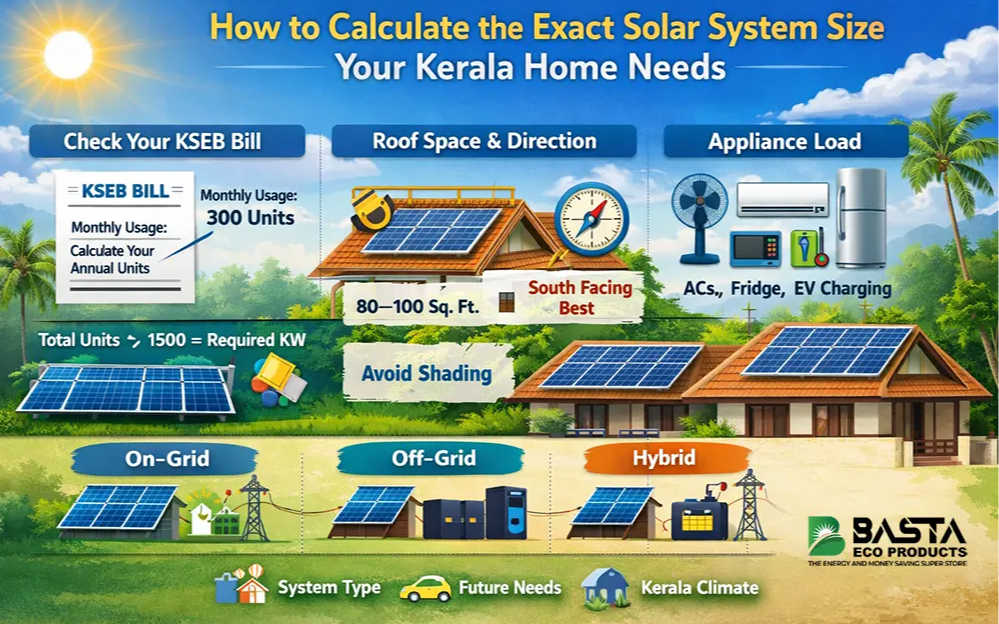
With Kerala’s sunlight potential and rising grid costs, it’s smart to go solar-ready from the start.
Solar hybrid inverters can charge your batteries from both the grid and solar panels, giving you free daytime energy and lower bills.
Key advantages:
- Reduced electricity expenses.
- Works even during power cuts.
- Compatible with net-metering and government subsidies.
Basta Eco Products, Kannur, offers advanced hybrid inverters and complete solar packages — including solar panels, charge controllers, and batteries — designed for homes, shops, and offices.
7. Step 6 — Brand Reliability and After-Sales Support
Choosing a reputed brand matters for long-term reliability. Look for:
- BIS certification
- Service availability in your area
- Genuine spare parts
- Warranty terms (minimum 2 years inverter, 3–5 years battery)
At Basta Eco, we partner with India’s leading inverter and battery brands, ensuring our customers get high-quality systems with solid warranties and Kannur-based support.
We also provide installation, monitoring, and maintenance, so you never have to worry about performance drops or servicing hassles.
8. Step 7 — Common Mistakes to Avoid
- Underestimating load – leads to frequent inverter trips.
- Using old batteries with new inverters – reduces efficiency.
- Ignoring ventilation – batteries need airflow to prevent heat buildup.
- Skipping maintenance – check terminals and fluid levels regularly.
- Choosing wrong wiring or fuse ratings – always follow manufacturer specs.
A professional installation by certified experts — like Basta Eco Products’ service team — eliminates all these risks.
9. Maintenance Tips for Long Battery Life
- Clean terminals regularly to prevent corrosion.
- Check electrolyte levels every 2–3 months for lead-acid types.
- Keep the area dry and ventilated.
- Avoid full discharge cycles.
- Service once a year for optimal performance.
Our AMC (Annual Maintenance Contracts) at Basta Eco make upkeep effortless — ensuring your power backup works flawlessly all year round.
10. Why Choose Basta Eco Products Kannur
Basta Eco Products isn’t just a dealer — we’re energy partners for a sustainable future.
We specialize in:
- Home and commercial inverter solutions
- Solar hybrid systems
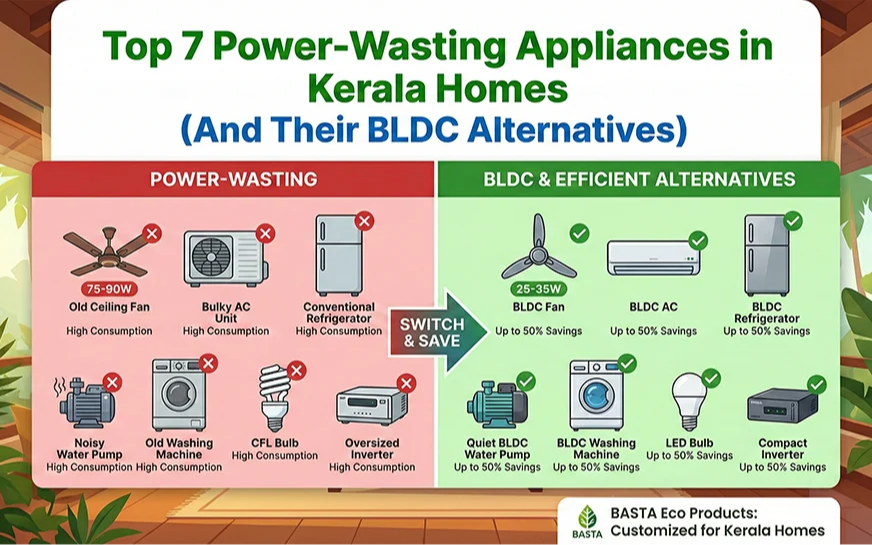
- BLDC energy-saving appliances
- Complete renewable power setups
What sets us apart:
- Expert guidance on load assessment and selection
- Trusted brands and genuine products
- Hassle-free installation and warranty
- Kannur-based service and quick support
- Sustainable solutions that save both money and the environment
When you choose Basta Eco, you’re choosing reliability, performance, and a greener tomorrow.
Final Thoughts
Choosing the right inverter and battery is more than a technical decision — it’s an investment in comfort, savings, and sustainability.
With the right guidance and products from Basta Eco Products, you can enjoy uninterrupted power, reduced bills, and peace of mind for years to come.
Whether you’re upgrading your existing system or planning a new installation, talk to the experts who understand Kerala’s homes and energy needs best — Basta Eco Products, Kannur.
Power smart. Live green. Go Basta Eco.