Email: info@bastaeco.com
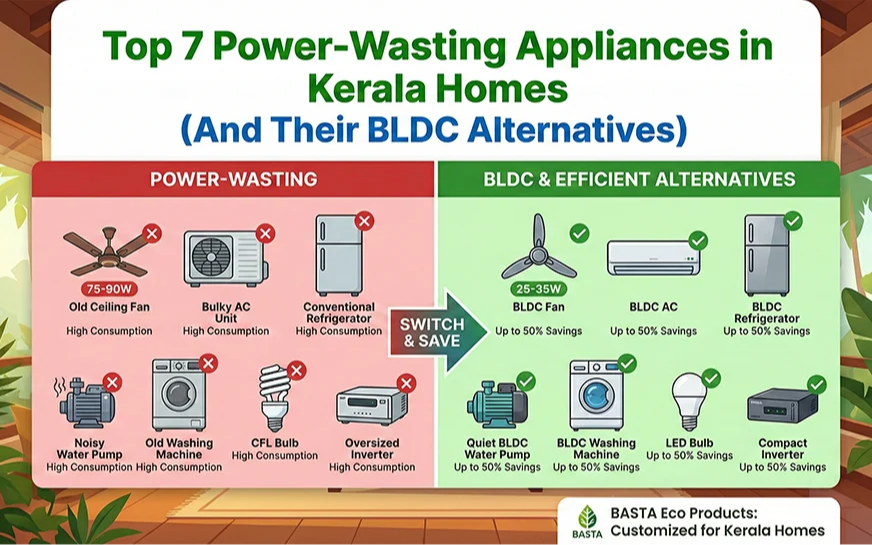
Top 7 Power-Wasting Appliances in Kerala Homes (And Their BLDC Alternatives)
A practical guide for Kerala homeowners identifying the most power-wasting household appliances and their BLDC alternatives. Learn how switching to energy-efficient technology can lower your monthly KSEB electricity bill.
Top 7 Power-Wasting Appliances in Kerala Homes (And Their BLDC Alternatives)
Electricity consumption in Kerala homes has increased sharply over the last few years. Longer appliance usage due to humidity, rising temperatures, and work-from-home culture has pushed many households into higher KSEB tariff slabs. While most homeowners blame electricity rates, the real issue is often power-wasting appliances running silently every day.
The good news? Most of these high-consumption appliances now have BLDC or energy-efficient alternatives that can drastically reduce your monthly electricity bill.
Let’s identify the top 7 power-wasting appliances commonly found in Kerala homes and see how switching to BLDC technology can help.
1. Conventional Ceiling Fans
Traditional ceiling fans consume 75–90 watts and often run for 8–12 hours daily in Kerala’s climate. This alone makes them one of the biggest contributors to electricity usage.
BLDC Alternative:
BLDC fans consume only 25–35 watts while delivering the same airflow.
Savings:
Up to 65% reduction in fan electricity consumption, making BLDC fans one of the fastest ROI upgrades for any home.
2. Old-Generation Air Conditioners
Non-inverter ACs and older models operate at fixed speeds, drawing high power even when cooling demand is low. Many Kerala homes still use ACs that consume 1600–2000 watts continuously.
BLDC Alternative:
BLDC or inverter ACs adjust compressor speed based on room temperature, consuming 40–50% less power.
Additional Benefit:
Better humidity control, which is crucial for Kerala weather.
3. Conventional Refrigerators
Older refrigerators run compressors at full speed regardless of cooling needs, leading to excessive power usage—especially during frequent door openings.
BLDC Alternative:
BLDC/inverter refrigerators use variable-speed compressors that operate efficiently throughout the day.
Savings:
Up to 50% lower electricity consumption, with quieter operation and longer compressor life.
4. Water Pumps with Fixed-Speed Motors
Water pumps are often overlooked, yet they consume high power during operation. Traditional pumps draw heavy current and waste energy during pressure fluctuations.
BLDC Alternative:
BLDC or variable-frequency pumps adjust motor speed based on demand.
Savings:
Reduced power draw, smoother operation, and improved compatibility with solar and inverter systems.
5. Old Washing Machines
Conventional washing machines use fixed-speed motors and inefficient cycles, leading to higher electricity and water consumption.
BLDC Alternative:
BLDC washing machines regulate drum speed precisely, reducing power usage and improving wash quality.
Savings:
Lower energy bills and less wear on clothes.
6. Lighting Systems Using CFL or Halogen Bulbs
Although LED adoption has increased, many homes still use CFL or halogen lights in certain areas, especially outdoors and staircases.
BLDC/Efficient Alternative:
LED lighting systems consume 80–90% less electricity and last significantly longer.
Impact:
Lower lighting load contributes to overall slab reduction in KSEB billing.
7. Oversized Inverters and Inefficient Backup Loads
Many homes use oversized or outdated inverters that waste energy during conversion and standby operation.
BLDC-Compatible Alternative:
Right-sized inverters combined with BLDC appliances reduce backup load, extend battery life, and improve efficiency.
This is where BASTA Eco Products plays a critical role by designing optimized inverter and solar backup solutions tailored for BLDC-based homes.
Why BLDC Appliances Matter More in Kerala
Kerala homes face:
- Long appliance usage hours
- Frequent voltage fluctuations
- High humidity and heat
- Rising KSEB tariffs
BLDC appliances address all these challenges by consuming less power, operating smoothly, and integrating seamlessly with solar and inverter systems.
At BASTA Eco Products Kannur, homeowners are advised to reduce load first using BLDC appliances before investing in solar power. This approach lowers system size, installation cost, and payback time.
The Financial Impact of Switching to BLDC
Replacing power-wasting appliances with BLDC alternatives can reduce home electricity consumption by 30–50%. For an average Kerala household, this translates to:
- ?1,500–?2,500 monthly savings
- ?18,000–?30,000 yearly savings
- Long-term protection from tariff hikes
Frequently Asked Questions (Q&A)
1. Which appliance should I replace first to save the most electricity?
Ceiling fans and ACs offer the fastest savings due to long daily usage in Kerala homes.
2. Are BLDC appliances expensive?
They cost more initially, but most recover the extra cost within 2–3 years through electricity savings.
3. Do BLDC appliances work well with inverters?
Yes. BLDC appliances draw less power, resulting in longer inverter backup time.
4. Can BLDC appliances reduce the size of a solar system?
Absolutely. Lower load means fewer solar panels and smaller batteries, reducing installation cost.
5. Does BASTA Eco Products provide BLDC and power-saving solutions?
Yes. BASTA Eco Products offers BLDC appliances, solar systems, inverters, and complete energy-efficient solutions customized for Kerala homes.
Final Note
Power savings don’t start with solar panels—they start inside your home. By identifying power-wasting appliances and replacing them with BLDC alternatives, Kerala homeowners can take full control of their electricity bills and build a future-ready, energy-efficient home.