Call us now: 90613 27222
Email: info@bastaeco.com
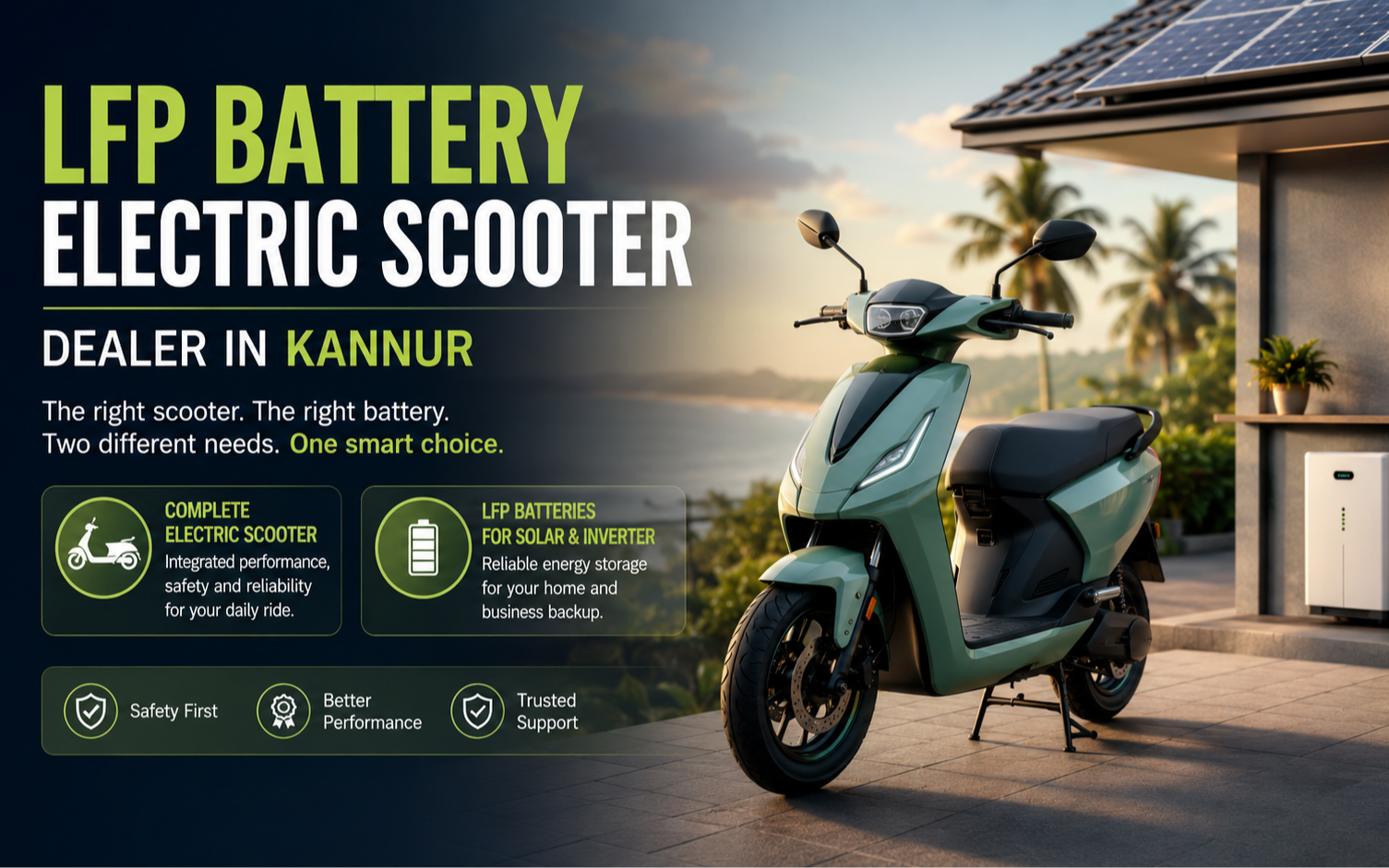
Best LFP Battery Electric Scooter Dealer in Kannur: A Buyer's Guide
People searching for the best LFP battery electric scooter dealer in Kannur are often looking for two different things: a dependable electric scooter that uses modern battery technology, or a loose replacement battery for an existing vehicle. Those are not the same purchase. Basta Eco sells complete electric scooters through its scooter dealership, but it does not sell standalone EV traction batteries. Its separate LFP battery solutions are intended for solar energy storage and inverter backup. Making that distinction at the beginning protects the buyer from choosing an incompatible product and helps the dealer recommend the correct solution.
An electric scooter is an integrated vehicle. Its battery pack, battery-management system, controller, charger, wiring, software and motor are engineered to work together. Even when a scooter model uses lithium iron phosphate, or LFP, chemistry, the pack is still a vehicle-specific component. A home-energy LFP battery is designed for a different voltage architecture, enclosure, charging pattern and use case. It must never be treated as a substitute for an approved traction battery.
If your goal is personal mobility, begin with the complete scooter and its authorised support route. If your goal is solar storage or backup during power cuts, explore Basta Eco's LFP battery solutions for solar and inverters.
Battery chemistry is important, but it is only one part of a good scooter decision. Range, charging access, riding comfort, braking, tyre and wheel design, water-resistance information, service availability and warranty terms matter just as much.
A professional dealer should ask where the scooter will be used, how far it will travel on a normal day, whether it will carry a pillion, and where it can be charged safely. Kannur riders may encounter rain, uneven surfaces, slopes, busy town traffic and coastal conditions, so a showroom-only comparison is not enough.
Start with a realistic daily-distance estimate rather than the largest advertised range. Published range figures are measured under defined conditions; actual range changes with speed, payload, gradients, tyre pressure, traffic, riding mode, temperature and accessory use.
A practical buyer keeps a sensible reserve instead of planning to reach home with the display at zero. Ask the dealer to explain which figure is certified, which is a manufacturer claim and what a typical local rider may experience. Honest context is more valuable than a single impressive number.
A traction battery is supervised by a battery-management system that monitors parameters such as cell voltage and temperature. The charger and controller must communicate correctly with the pack. Changing the chemistry, nominal voltage, current capability, connector or software assumptions can create a serious safety and reliability risk.
That is why buyers should follow the vehicle manufacturer's instructions for charging, storage, inspection and replacement. Any battery-related diagnosis should go through the authorised service process for that scooter.
Ask for written clarity on the vehicle warranty and the battery warranty, because the duration, mileage limits and exclusions may differ. Confirm what happens if the scooter is exposed to flooding, modified wiring, an unsuitable charger or an unauthorised repair.
Keep the invoice, warranty documents, charger details and service records. A good dealer explains these conditions before the sale and does not promise that every form of damage will be covered.
The dealer should match the vehicle to your route, daily distance, load and charging situation.
Evaluate low-speed balance, seat comfort, turning radius, braking feel, visibility and ease of putting the scooter on its stand.
Confirm the exact variant, certified range, battery information and included charger from the latest official product sheet.
Request an itemised quotation showing ex-showroom price, registration, insurance, accessories and any current offer separately.
Ask what electrical socket, earthing, weather protection and ventilation are required at the charging point.
Understand scheduled checks, complaint registration, roadside or pickup options, consumable costs and likely parts lead times.
Before accepting the vehicle, check body panels, tyres, lights, brakes, display, charger, keys, documents and battery state of charge.
This process is more reliable than selecting a dealership only because its page uses the word "best." The best dealer for an individual customer is the one that gives verifiable specifications, a transparent quotation and a workable support plan after delivery.
Basta Eco's electric scooter dealer page for Kannur is the appropriate starting point for complete scooters and test-ride enquiries.
Use only the charger specified for the vehicle. Charge in a dry, ventilated location with a sound electrical connection, and do not use damaged extension boards or loose sockets. Keep the charger and connector away from standing water.
After riding through heavy rain or waterlogging, follow the manufacturer's inspection guidance before connecting the charger. If the pack, cable or charger shows unusual heat, smell, swelling, impact damage or repeated error messages, stop using it and contact authorised service.
Tyre pressure and brake condition affect both safety and energy use. Extra load, aggressive acceleration and sustained high speed can reduce the available range. Software updates and periodic inspection may also affect performance and diagnostics.
These routine habits do not require technical experimentation; they require consistency and use of the approved service channel.
A homeowner who asks for an "LFP battery" may actually want quiet backup for lights, fans, internet equipment and selected appliances, or storage for a solar system. That is a stationary-energy project, not an electric-vehicle project.
The correct battery is selected only after reviewing the inverter's supported battery voltage and charging profile, the required backup load, desired runtime, installation environment and protection devices.
Basta Eco supplies LFP batteries for these solar and inverter applications; it does not supply them as loose EV replacement packs.
Do not size a backup system by battery capacity alone. First list essential loads in watts, decide which loads must never be connected, estimate simultaneous demand and choose a realistic backup duration.
Then confirm inverter compatibility and the usable capacity specified by the relevant manufacturer. Air conditioners, pumps, heaters and other high-demand appliances need special attention because their starting and continuous loads can be very different from those of lights or fans.
Basta Eco Products Kannur LLP operates from Basta Tower, opposite Krishna Menon Women's College, Pallikkunnu, Kannur.
Customers can discuss complete electric scooters, energy-efficient appliances, solar solutions, inverters and stationary LFP storage in one place. The important point is that each solution is scoped separately. A scooter test ride does not turn a home battery into an EV component, and an inverter assessment does not replace vehicle service.
Bring your approximate daily travel, normal passenger load, charging location and questions about warranty when enquiring about a scooter.
For stationary backup, bring a list of essential appliances, their wattages where available, the present inverter model and the desired runtime. Better input produces a more accurate recommendation and a clearer quotation.
No. Basta Eco does not sell loose EV traction or replacement batteries. It sells complete electric scooters through the scooter dealership, while its separate LFP battery range is for compatible solar storage and inverter backup systems.
No. Stationary and traction batteries have different electrical, mechanical, thermal and communication requirements. Use only the battery and service procedure approved by the scooter manufacturer.
No. The complete system matters: battery management, controller, charger, motor, chassis, brakes, tyres, software, warranty and local service support should all be evaluated.
Bring a valid driving licence where required, your typical route and distance, expected load, charging details and a list of features you need. Confirm test-ride requirements with the showroom before visiting.
Use Basta Eco's LFP battery page or contact the Kannur store for a load and compatibility assessment. Mention clearly that the requirement is for solar storage or inverter backup, not an electric vehicle.
How to Choose the Best BLDC AC Dealer in Kannur
 December 24, 2026
December 21, 2026
December 18, 2026