Call us now: 90613 27222
Email: info@bastaeco.com
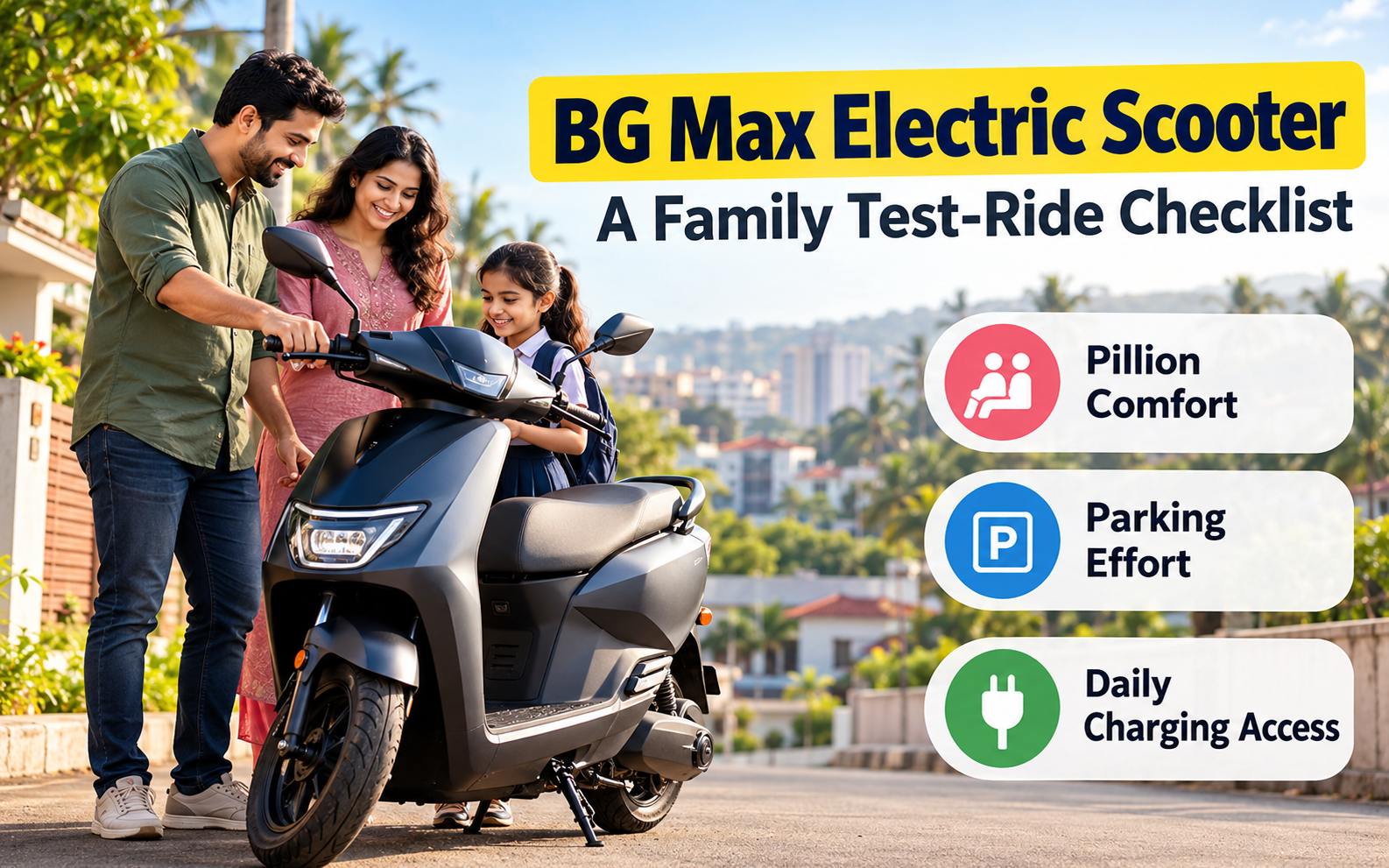
BG Max Electric Scooter in Kannur: A Family Test-Ride Checklist
Searching for BG Max Electric Scooter is a useful starting point, but a good decision needs a specific everyday task. This guide focuses on a family sharing one scooter for office travel, school errands and weekend shopping. The main priorities are pillion comfort, parking effort and daily charging access. Use the questions below to turn a broad search into a clear conversation with a local supplier. The purpose is to help you compare evidence and practical requirements; words such as best describe the buyer’s intention and do not establish an independent market ranking.
A family purchase should consider every regular rider. The person paying for the scooter may not be the person using it most often. Ask each rider to check foot placement, reach to the handlebars, visibility and confidence at walking speed. A comfortable demonstration for one tall rider does not answer the needs of a shorter family member.
BG Max is a model-family search term. Match the quotation to the precise C12 or other currently offered variant, with the manufacturer specification sheet beside it. Do not transfer battery, range or storage information from a different variant. Ask the showroom to identify the battery warranty and charger supplied with that exact vehicle.
Practise a controlled stop, a slow turn and moving the vehicle into a parking space. Check how confidently the rider can place a foot down without stretching. With dealer approval, assess pillion seating and mounting. These ordinary movements often reveal more about family suitability than a brief straight-road acceleration demonstration.
Decide who checks the charge before the next morning and where the approved charger will be stored. A scooter that serves several people needs a predictable routine. Keep the charging area dry and accessible without running a cable across a walkway. Ask an electrician to assess the proposed outlet before delivery.
Consider a family sharing one scooter for office travel, school errands and weekend shopping as the reference case. Start a short worksheet with three columns: the requirement, the evidence available and the question still unresolved. Put pillion comfort in the first row, parking effort in the second and daily charging access in the third. For each row, write a specific fact instead of a general impression. Where the fact is unknown, keep the question open until a document, site assessment or appropriate demonstration supplies an answer.
Next, use the four main checks in this guide as the appointment agenda: start with the people using the scooter; evaluate the bg max variant actually quoted; check everyday stops and starts; and make a shared charging routine. Explain which of these affects your decision most. Ask the supplier to identify what can be confirmed immediately and what needs further assessment. This gives the meeting a useful sequence and prevents minor optional features from taking all the time available.
After the discussion, compare the response with your original requirements. A useful answer may include a limitation, a different model or a request for more information. Treat that clarification as part of the assessment. Write the agreed next step and the person responsible for it. If the proposal changes, update the worksheet rather than keeping contradictory quotations or specifications together. This simple record helps another household member understand why the eventual choice was made.
A useful quotation states the model and variant, included charger, insurance, registration where applicable and optional accessories separately. Mark its validity date and ask what can change before delivery. If finance is being considered, request the lending terms independently of the vehicle comparison. This allows the household to understand both the product cost and the borrowing commitment without mixing them into a single attractive monthly figure.
A demonstration is valuable for assessing seating, control reach, balance and manoeuvring. It is less useful for proving complete battery range or long-term reliability. Write observations in those separate categories. When a question requires a document, ask for the current model sheet or warranty text. When a question requires personal experience, use an appropriate demonstration. Matching the evidence to the question makes the final decision stronger.
Kannur journeys can combine busy streets, quieter lanes and routes with gradients. Describe your own journey rather than assuming all local riders share one pattern. A scooter selected for short errands may be judged differently from one used for a longer commute. Explain parking space and regular pillion use as well. These practical facts help the dealer narrow the models before you spend time comparing small optional features.
Read the separate vehicle, battery and charger terms where applicable. Confirm time and mileage conditions, required maintenance and the process for making a claim. Ask about exclusions involving modifications or unsuitable charging equipment. Save the invoice and documents in a place that is easy to access. A warranty conversation is most useful before purchase, when its limitations can still influence the selection and your ownership routine.
A new job, an additional rider or a different parking arrangement can change whether a scooter remains convenient. Consider likely changes without buying around every imaginary possibility. Leave reasonable flexibility in range and charging access, then confirm your actual essentials. If the normal journey later changes substantially, review the charging routine and service schedule. The initial comparison should create a practical habit of checking requirements rather than a permanent assumption.
Record the charger model and follow the vehicle documentation for use and storage. Similar connector shapes are not evidence that another charger is suitable. Keep the cable protected from damage and locate the equipment according to its ventilation and weather guidance. If an electrical problem arises, send clear details to the supported service team. Changing adapters or opening sealed components can complicate both safety and the diagnosis of the original complaint.
Suitability depends on rider fit, payload limits, route and charging access. Test the current variant with the people who will actually ride it before making the decision.
Yes, when possible. Ask the dealer how to assess seating, footrests and mounting safely, and check the manufacturer payload limits rather than assuming unlimited carrying capacity.
No. Pillion weight, gradients, traffic, speed and tyre pressure affect actual range. Discuss the regular route and leave a reserve for unexpected trips.
Use only the charger approved for that scooter. Agree a shared routine and storage location; another electric vehicle charger is not automatically compatible.
Contact Basta Eco with the desired variant and the number of riders attending. Demonstrator availability and test-ride conditions should be confirmed before travel.
Explore electric scooters in Kannur and contact Basta Eco with the details relevant to this guide. The Kannur showroom is at Basta Tower, opposite Krishna Menon Women’s College, Pallikkunnu, Kannur 670004. Ask for current model availability, supported service and a written scope before arranging the visit. Product specifications, quotations and appointment availability should be reconfirmed for your chosen equipment.
Ask on WhatsApp or call Basta Eco. Share your priorities for pillion comfort, parking effort and daily charging access so the team can prepare a focused response.
Which Electric Scooter Is Best in Kerala? Compare Your Route First
 December 24, 2026
December 21, 2026
December 18, 2026