Call us now: 90613 27222
Email: info@bastaeco.com
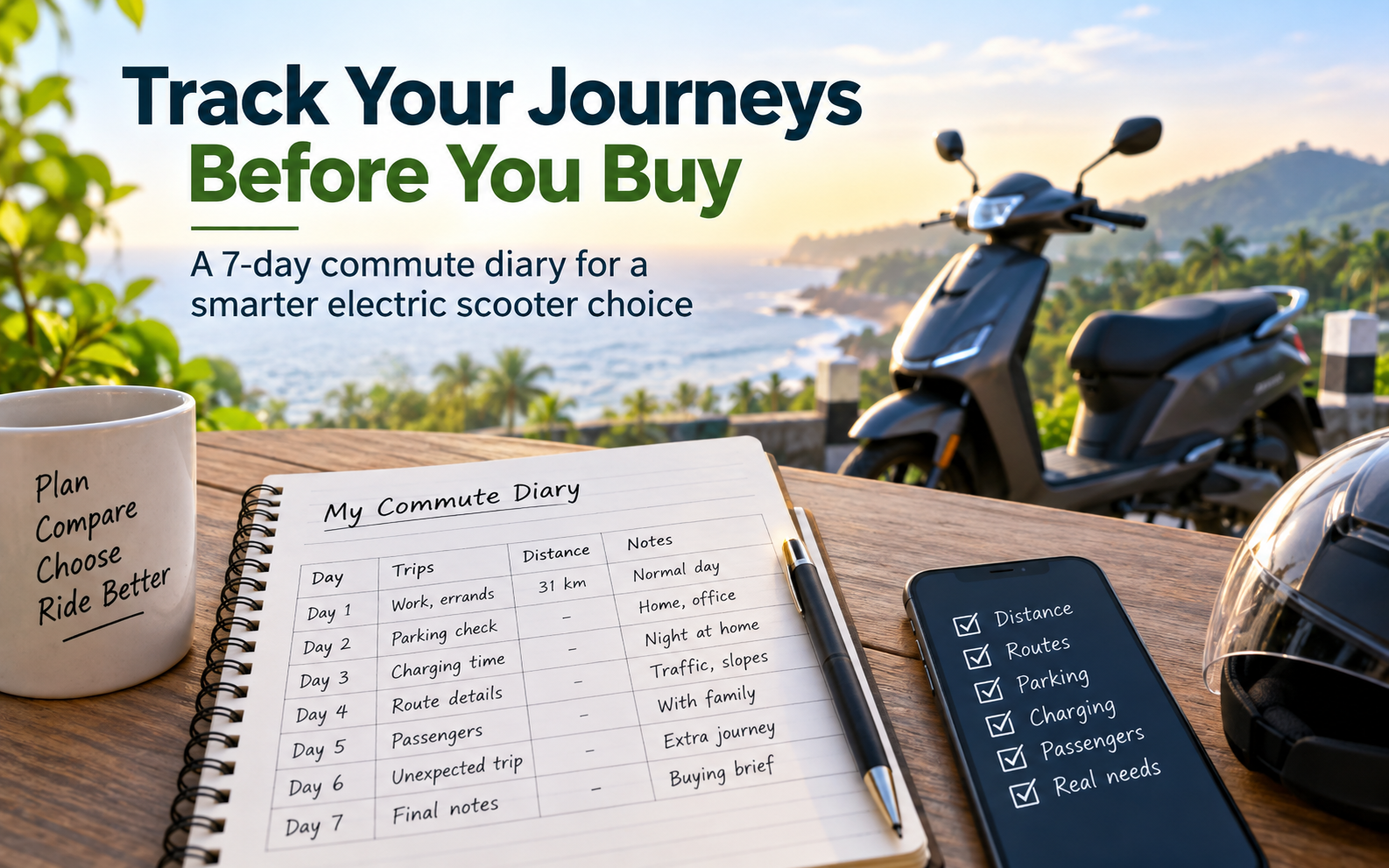
The Seven-Day Commute Diary: Prepare for Your First Electric Scooter
Before choosing an electric scooter, spend seven days paying attention to the journeys you already make. This small exercise can reveal more than a long list of specifications. Many people remember their office distance but overlook evening errands, passenger trips, parking difficulties, and the days when plans change. A commute diary turns those details into a practical buying brief that you can take to a showroom in Kannur.
You do not need a special application or an expensive measuring device. A notebook, your existing vehicle's odometer where available, and a few minutes at the end of each day are enough. The aim is to understand your travel pattern, not to produce a laboratory measurement. Keep the process simple enough that you actually complete it.
Start with a normal working day. Write down your starting point, destination, approximate distance, and purpose for each trip. Record the return journey separately if the route differs. A stop at a shop may seem too minor to mention, but several such trips can change the amount of travel your future scooter must support.
For example, an imagined household might travel 12 kilometres to work, 12 back, four for an evening errand, and three for a school-related detour. The daily total is 31 kilometres rather than the 24 remembered as the commute. This example is not a claim about typical Kannur travel. It simply shows why your complete day is a better planning unit than one familiar route.
Record your parking location at home, at work, and at regular stops. Is the space covered? Is it shared? Must you push the vehicle backwards through a gate? Are you parking on a slope or moving around other vehicles? These observations can affect your model choice even when every scooter under consideration offers enough range.
Measure a narrow gate or turning space if it could be a concern. Do not rely on memory while standing beside a showroom vehicle. A few dimensions and a sketch allow a more useful conversation about size and manoeuvrability. If access depends on moving another family member's vehicle, include that detail too. The best daily arrangement is one that remains convenient when everyone is in a hurry.
Write down when the vehicle normally arrives home and when it leaves again. Note whether the same parking space is available throughout that period. This reveals the charging window you could realistically use. A theoretical overnight stay is less useful if the socket is inaccessible or the parking position changes every evening.
Make a separate list of questions for the dealer and, where needed, a qualified electrician. Ask about the supplied charger's requirements, suitable installation, cable routing, and the manufacturer's charging instructions. If you rent or use shared parking, establish permission. Do not assume that workplace charging, public charging, or battery removal is available for the model you eventually select. Record those options only after they are confirmed.
Two journeys of equal distance may feel very different. One could involve frequent stops and tight turns, while the other follows a more open road. Note steep sections, rough surfaces, busy junctions, and areas where you need to maintain careful balance at low speed. These details help shape a useful test ride request.
Also record the circumstances that make a trip tiring. Perhaps you spend a long time waiting in traffic, find your current seat uncomfortable, or struggle to read the instrument display. These are ownership requirements, even though they may not appear in a range comparison. A suitable scooter should improve the daily experience that prompted you to consider changing vehicles in the first place.
List who travels with you and what you carry. A solo office commute and a school run with a passenger place different demands on seating and storage. Note your normal bag dimensions and whether you carry shopping on the return trip. Avoid reducing the whole question to whether the scooter has a large storage number.
Bring representative belongings to the showroom and check them with permission. Confirm the manufacturer's load limits and approved carrying arrangements. If two adults will share the scooter, both should assess reach, seating, and handling. The person who pays for a vehicle is not always the person who rides it most, so the regular user's comfort deserves direct attention.
Think about a realistic disruption that occurred recently: an extra journey after work, a delayed return, a change in parking, or a forgotten item that required going back. Record the extra distance and time. If nothing unusual happens during your diary week, add one clearly labelled scenario based on a genuine past experience.
This is a way to identify the reserve you value. You might prefer a model that makes an occasional extra trip easy, or you might decide that a rare long journey can use another form of transport. Either choice can be reasonable. What matters is making it consciously instead of discovering the limitation after purchase, when your options are less convenient.
Review the week and identify your ordinary daily distance, longest recorded day, passenger frequency, charging window, and most awkward parking manoeuvre. Separate actual observations from estimates. There is no need to average away important differences: a demanding day that occurs every week deserves more attention than a quiet Sunday.
Write a short brief in plain language. For example: I normally cover around 30 kilometres, sometimes need 45, carry a work bag, park behind a narrow gate, and can charge only at home. This is a hypothetical format, not a recommended range requirement. Your own completed sentence gives the salesperson something concrete to work with and helps prevent the discussion from drifting into unrelated features.
Ask for a test ride that allows you to assess the movements you identified. You may need to check low-speed balance, restarting after a stop, comfortable braking, or moving the scooter into a parking position. Follow the dealer's procedure and traffic conditions. There is no need to seek difficult roads or perform abrupt manoeuvres to make the test useful.
After each model, write down what felt easy and what remained uncertain. Use the same questions for every scooter so the comparison stays fair. A model with an attractive display may still be awkward for your regular rider; another with less dramatic advertising may suit your routine well. Specific observations are more dependable than trying to remember an overall impression several days later.
Once your weekly distance is clear, you can discuss running costs without relying on a universal savings claim. As an illustrative calculation, 180 kilometres each week over four weeks gives 720 kilometres. If a hypothetical scooter uses 0.04 kWh from the wall per kilometre, that would be 28.8 kWh for the period. This is arithmetic using an assumed consumption figure, not a specification for any BGauss product.
Replace that assumption with reliable information relevant to your intended model and usage. Use the applicable electricity charges from your own bill when estimating energy expense, and keep purchase cost, insurance, maintenance, and finance costs separate. This article does not quote a current KSEB tariff. A transparent calculation with labelled assumptions is easier to revise than a broad promise about monthly savings.
A commute diary is useful evidence, but one week may not capture holidays, changing work schedules, or seasonal travel. Add any known recurring journeys that were absent. If your job location is about to change, prepare a second scenario rather than assuming your present pattern will continue indefinitely.
The diary also cannot establish a particular scooter's battery lifespan, service quality, or real-world range by itself. Those questions require model-specific documentation, a dealer discussion, and an honest understanding of operating conditions. Keep each type of information in its proper place. Your notes describe the task you need the scooter to perform; they do not substitute for verified product specifications.
With a completed diary, you can ask which available models fit your actual route, what charging preparation is needed, and which storage arrangements accommodate your belongings. Request a complete written quotation and the relevant warranty and service documents. Record any unanswered questions before making a booking decision.
If you are exploring an electric scooter in Kannur, share your commute requirements with Basta Eco. A week of simple observations can make the conversation shorter, clearer, and more useful. You arrive with a description of everyday life, allowing the product discussion to focus on how a scooter would actually fit into it.
How to Compare Solar Quotations in Kannur: A Homeowner Worksheet
 September 12, 2026

September 10, 2026


September 5, 2026

September 4, 2026