Call us now: 90613 27222
Email: info@bastaeco.com
How to Choose the Best BLDC AC Dealer in Kannur
Share this post:
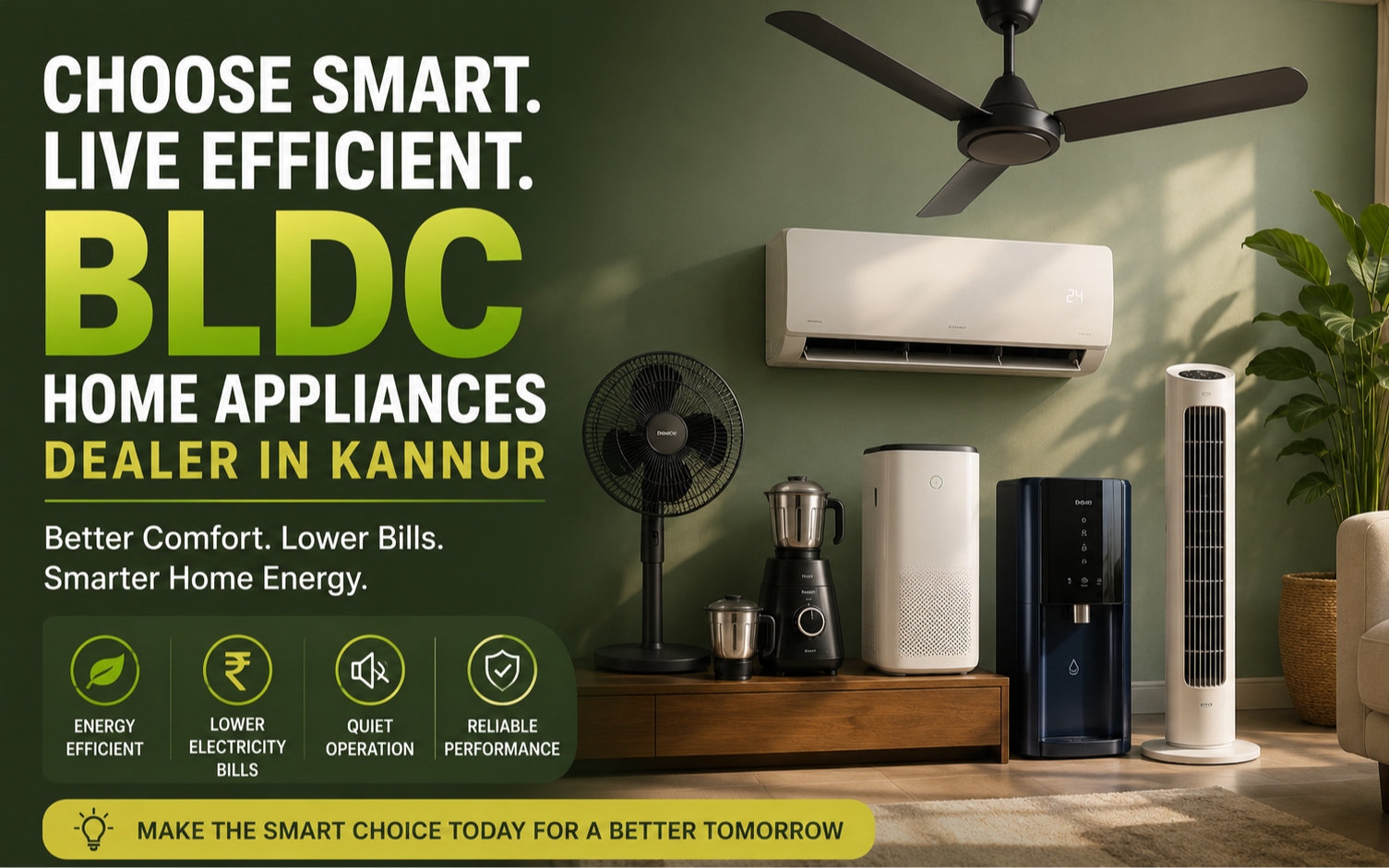
Best BLDC Home Appliances Dealer in Kannur: Practical Buying Guide
A search for the best BLDC home appliances dealer in Kannur usually begins with a wish to reduce electricity use without giving up comfort. The strongest result comes from choosing the right appliance for each room, checking model-level efficiency information, and buying from a dealer who can support installation and warranty. BLDC technology can improve motor efficiency and control, but it is not a magic label that makes every product suitable for every household.
Basta Eco offers a selection of energy-efficient appliances and helps customers connect individual purchases to a broader home-energy plan. The BLDC home appliances page is a useful starting point for current options. Before visiting, make a simple list of the appliances used for the most hours each day. A fan running through the night may be a better first upgrade than a device used for ten minutes each week.
BLDC stands for brushless direct current. In a BLDC motor, electronic control replaces the mechanical brush arrangement used in some motor designs. The technology can provide efficient variable-speed operation, compact size and precise control when the complete product is well engineered. In household products, however, efficiency depends on more than the motor. Blade design, airflow path, bearings, power electronics, sensors, software and the way the appliance is used all influence the outcome.
That is why buyers should compare actual power input, capacity, airflow or output, relevant energy label, operating modes, noise, warranty and service - not the motor name alone. An efficient fan that does not deliver enough air for its room may be run on boost continuously. A feature-heavy appliance may use standby power or become frustrating if its controls are poorly matched to the household. Good selection balances measured performance and everyday usability.
Begin with a home energy inventory. For each major appliance, note the rated watts from its label and the approximate hours used per day. Estimated monthly energy can be calculated as watts multiplied by daily hours and days, divided by 1,000. This is an estimate rather than a bill guarantee, but it reveals which devices deserve attention. Three bedroom fans used for long hours can represent a more meaningful opportunity than a rarely used small appliance.
Next, consider comfort and condition. Replacing a working appliance has an environmental and financial cost, so an immediate whole-house replacement is not always sensible. Prioritise old, inefficient or unreliable units; appliances used for long hours; rooms where remote or timer control would improve habits; and purchases already required for a new home. A phased plan lets the family evaluate performance before standardising on more units.
Check sweep size, air delivery, speed, top-speed wattage, remote functions, voltage range stated by the manufacturer, down-rod options and warranty. Room size and ceiling layout matter. Large rooms may need more than one properly positioned fan rather than a single oversized fan. For bedrooms, consider indicator-light brightness, remote accessibility and noise. For coastal or semi-open spaces, ask about blade and finish suitability without assuming that every model is weatherproof.
For ACs, cooling-load assessment and installation quality are essential. Compare the exact model's applicable BEE information, capacity, operating range, filtration needs and service plan. Air coolers work differently and depend on ventilation and local humidity; they should not be presented as direct replacements for refrigerated air conditioning in every room. The dealer should explain the use case honestly.
Mixer grinders, juicers and water purifiers may use advanced motors or electronic controls, but buyers should first examine task fit, capacity, jar or filter replacement, cleaning, safety interlocks, consumables and service. A purifier requires a water-quality-based recommendation; no single treatment combination is ideal for every source. Ask what tests or source information support the recommendation and what the annual filter cost may be.
India's Bureau of Energy Efficiency uses labels to help consumers compare the energy performance of similar products. A label belongs to a specific model and validity period. When a category is covered, scan or verify the label details and compare equivalent products. Do not transfer a brand's rating from one model to another, and do not compare star counts across unrelated appliance categories as if they represented the same test.
For products without a directly comparable mandatory label, request a manufacturer datasheet. Record wattage, output measure, test condition, warranty and model number. Savings percentages on competitor pages are often based on a particular conventional baseline and usage assumption. Ask for that baseline. A transparent dealer should be comfortable replacing a broad slogan with a simple calculation.
Ask how a complaint is registered, what information is needed, which faults are covered, and whether home service is available for the selected model and location. Avoid assuming that "onsite warranty" means every visit and component is free. Written warranty conditions are the reliable source.
Lower-wattage appliances can make a backup system more useful because the same stored energy may support essential loads for longer. This does not mean every BLDC appliance can be connected to every inverter. The system still needs adequate continuous and surge capacity, correct wiring and an agreed essential-load circuit. Air conditioners, pumps and heating appliances require separate assessment.
If the home is planning solar, map daytime and evening loads. Solar generation may offset daytime consumption, while a compatible inverter and LFP battery can support selected loads later. Basta Eco supplies stationary LFP batteries for solar and inverter backup; these are not EV replacement batteries. Treat solar, storage and appliances as coordinated systems, not interchangeable products.
Take room dimensions, photographs, existing appliance wattages and recent electricity bills to the consultation. Bills reveal total consumption but not the exact share of each appliance, so combine them with usage estimates. Ask for two or three suitable options: an essential-value choice, a balanced choice and a premium choice. Each should show why it fits, not just how it differs in colour or smart features.
Before paying, confirm price, taxes, delivery, installation, old-unit handling if offered, accessories, warranty registration and return conditions. At delivery, check the model and colour against the invoice, inspect for damage, retain packaging as advised, and test every control. Register the warranty promptly if the manufacturer requires it.
For many Kannur homes, a practical sequence is high-use fans first, necessary appliance replacements next, cooling optimisation after a room assessment, and solar or backup planning based on measured loads. Review results after the first billing cycles while accounting for seasonal changes. The aim is not to chase a single dramatic percentage; it is to improve comfort per unit of electricity over the life of the products.
The best BLDC home appliances dealer in Kannur will help the family make that sequence clear, supply verifiable model information and remain reachable when support is needed. That combination creates more value than a shelf full of products without guidance.
BLDC motor technology can be efficient, but actual consumption depends on the complete model, load, speed and usage. Compare model-level wattage, output and applicable energy information.
Usually start with an inefficient appliance used for many hours, such as a bedroom or living-room fan. Calculate approximate monthly energy and consider product condition before deciding.
Many can, but compatibility and total load must be checked. The inverter must support the combined continuous and starting demand of all connected appliances.
No. Timers and automation can improve habits, but core efficiency, correct sizing and sensible use matter first. Buy smart features when the household will genuinely use them.
Ask for the exact model, specifications, energy label where applicable, warranty, included accessories, installation scope, service route, final price and recurring consumable cost.
How to Choose the Best Energy Saving and Eco Friendly Dealer in Kannur
 December 24, 2026
December 21, 2026
December 18, 2026