Call us now: 90613 27222
Email: info@bastaeco.com
Best BLDC Home Appliances Dealer in Kannur: Practical Buying Guide
Share this post:
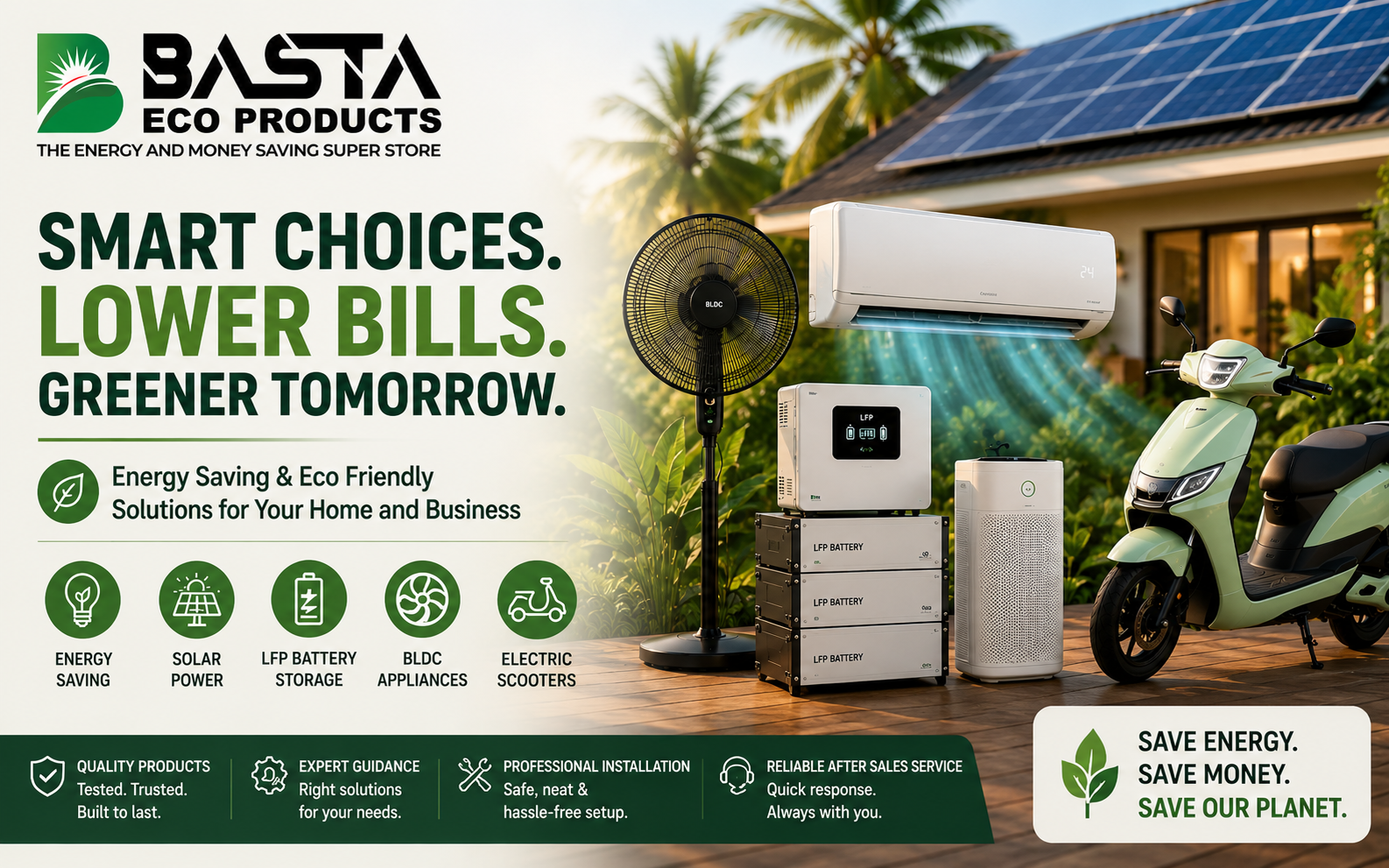
How to Choose the Best Energy Saving and Eco Friendly Dealer in Kannur
The best energy saving and eco friendly dealer is not the business with the longest list of green claims. It is the one that helps a customer reduce avoidable energy use with suitable products, transparent calculations, dependable installation and a plan that can be maintained. In Kannur, that plan may include efficient fans and cooling, solar generation, a correctly sized inverter, stationary LFP storage and an electric scooter. Each serves a different purpose, so the right combination starts with the customer's actual load and priorities.
Basta Eco brings several of these categories together, but a professional recommendation should never assume that every customer needs all of them. A rented flat, an independent house, a clinic and a retail shop have different control over the roof, wiring and operating schedule. The first step is to understand where energy is being used and which changes are technically and financially practical.
"Eco friendly" can mean lower electricity consumption, increased use of renewable generation, reduced fuel use, longer product life, safer disposal or greater resilience during power cuts. Rank these goals. A family concerned mainly about a high electricity bill may begin with appliance use and cooling. A business needing daytime power may investigate on-grid solar. A home with frequent outages may prioritise an efficient essential-load circuit and compatible storage.
Set a baseline using recent electricity bills, typical operating hours and a list of major loads. One month is rarely enough because weather, visitors, business activity and billing cycles vary. Where practical, use several months and note seasonal cooling demand. A dealer should explain which part of a proposal addresses consumption, which part changes the energy source, and which part provides backup. Solar panels do not make inefficient habits disappear, and a battery stores energy rather than generating it.
A useful order is: remove waste, improve efficiency, then size generation and storage for the remaining requirement. Fixing a poorly sealed cooled room, cleaning filters, correcting controls and replacing selected long-hour loads can reduce the capacity that must later be supplied. This may lower system cost and improve backup duration.
For fans, compare wattage and air delivery at the required sweep. For air conditioners, use a room load assessment and current model-level energy information. For pumps, refrigeration and commercial equipment, consider duty cycle and starting demand. Lighting upgrades should also account for light level, glare, colour quality and fixture life, not watts alone. The best solution maintains the service the user needs while using less energy to provide it.
On-grid solar is typically planned to offset eligible daytime and grid-supplied consumption under the applicable connection and utility process. It generally should not be assumed to power a property during a grid outage. Hybrid systems can combine more functions, but their behaviour depends on the inverter, battery, changeover design, protected-load circuits and programmed settings. Ask the dealer to describe normal operation, outage operation, battery charging priority and system limitations in plain language.
Roof area, shade, orientation, structure, cable route, earthing, protection, access and local approvals influence the proposal. A quotation based only on the electricity bill may miss these constraints. Request a site survey and a written equipment schedule. Compare module and inverter models, mounting approach, protection devices, monitoring, workmanship warranty and service response - not price per kilowatt in isolation.
LFP batteries can be used for compatible solar storage and inverter backup. Basta Eco does not sell standalone EV replacement batteries; its LFP solutions are for stationary applications. The design should begin with essential loads, simultaneous watts and desired runtime. Keeping high-demand equipment off the backup circuit can make a smaller system more useful and predictable.
Confirm that the inverter supports the battery voltage, charging profile and communication requirements specified for the proposed product. Review usable capacity, continuous output limits, protection, enclosure, ventilation, installation clearances and warranty conditions. Do not mix unmatched components or assume that any lithium battery can replace any other battery without system validation.
An electric scooter can reduce petrol use for suitable trips, but the decision should be based on daily route, range margin, charging, comfort, warranty and authorised service. A complete scooter is an integrated vehicle. Its traction battery should be maintained and replaced only through the approved vehicle process. Home-energy batteries and EV packs are not interchangeable.
Calculate mobility cost using realistic kilometres, charging energy, electricity tariff, insurance, service and financing - not fuel savings alone. A test ride is essential. For customers exploring this category, Basta Eco's electric scooter dealership information provides the correct enquiry path.
Competitor websites frequently highlight large percentage savings, quick payback or a very broad product range. Those claims should inspire questions, not replace analysis. A credible dealer will show assumptions and acknowledge uncertainty. Payback changes with usage, tariff, system cost, maintenance, finance and future behaviour; it cannot be identical for every customer.
The sales counter is only one part of the experience. Ask who surveys the site, who installs, who commissions, and who handles a later complaint. Confirm licences or competencies relevant to the work, manufacturer authorisation where claimed, and the process for warranty registration. For solar and electrical projects, the proposal should include appropriate protection and documentation rather than treating them as optional extras.
A complete quotation should identify equipment, quantities, taxes, delivery, installation, exclusions, expected schedule, payment milestones, warranty and handover documents. Avoid paying for a system described only by category and capacity. At completion, keep invoices, serial numbers, datasheets, warranty certificates, settings, test results where supplied and contact details.
Phase one can focus on measurement and low-cost corrections: usage schedules, thermostat habits, filter care, lighting controls and identifying long-hour loads. Phase two can replace priority appliances with efficient models, including suitable BLDC fans or correctly sized cooling. Phase three can evaluate on-grid solar or a hybrid design based on roof and load. Phase four can add compatible stationary storage when backup requirements justify it.
Review performance after each phase. Compare similar seasonal periods, not one rainy month with a very hot month. Check whether comfort, reliability and operating habits changed. If results differ from the estimate, investigate usage and system condition before adding more equipment. Continuous improvement is more credible than a one-time green purchase.
Kannur's humidity, monsoon, coastal exposure and mix of urban and semi-urban properties affect placement and maintenance. Roof access, shade, salt air, drainage and electrical quality should be considered. A local consultation makes it easier to review these conditions and coordinate service. Basta Eco Products Kannur LLP is located at Basta Tower, opposite Krishna Menon Women's College, Pallikkunnu, Kannur.
The best energy saving and eco friendly dealer should help you purchase less wastefully, operate products correctly and understand the evidence behind expected results. That standard turns "green" from a slogan into a measurable household or business plan.
Start with waste and long-hour loads. Review bills, wattages and usage, then prioritise inefficient fans, cooling or other equipment that runs frequently and is due for replacement.
No universal result can be promised. System size, generation, consumption timing, weather, tariff, utility rules and fixed charges affect the bill. Request an assumption-based estimate.
A battery stores energy; it does not generate it. Its value depends on the application, compatible system design, lifetime use and responsible end-of-life handling.
No. Basta Eco's LFP batteries are for compatible solar and inverter backup. EV traction-battery work should follow the vehicle manufacturer's authorised service route.
Make both vendors use the same load, operating hours, tariff and scope. Compare exact models, installation, protections, warranties, maintenance, exclusions and service responsibility.
Best LFP Battery Dealer in Kannur for Solar and Inverter Backup
 December 24, 2026
December 21, 2026
December 18, 2026