Call us now: 90613 27222
Email: info@bastaeco.com
Best LFP Battery and Inverter Dealer: Compatibility and Sizing Guide
Share this post:
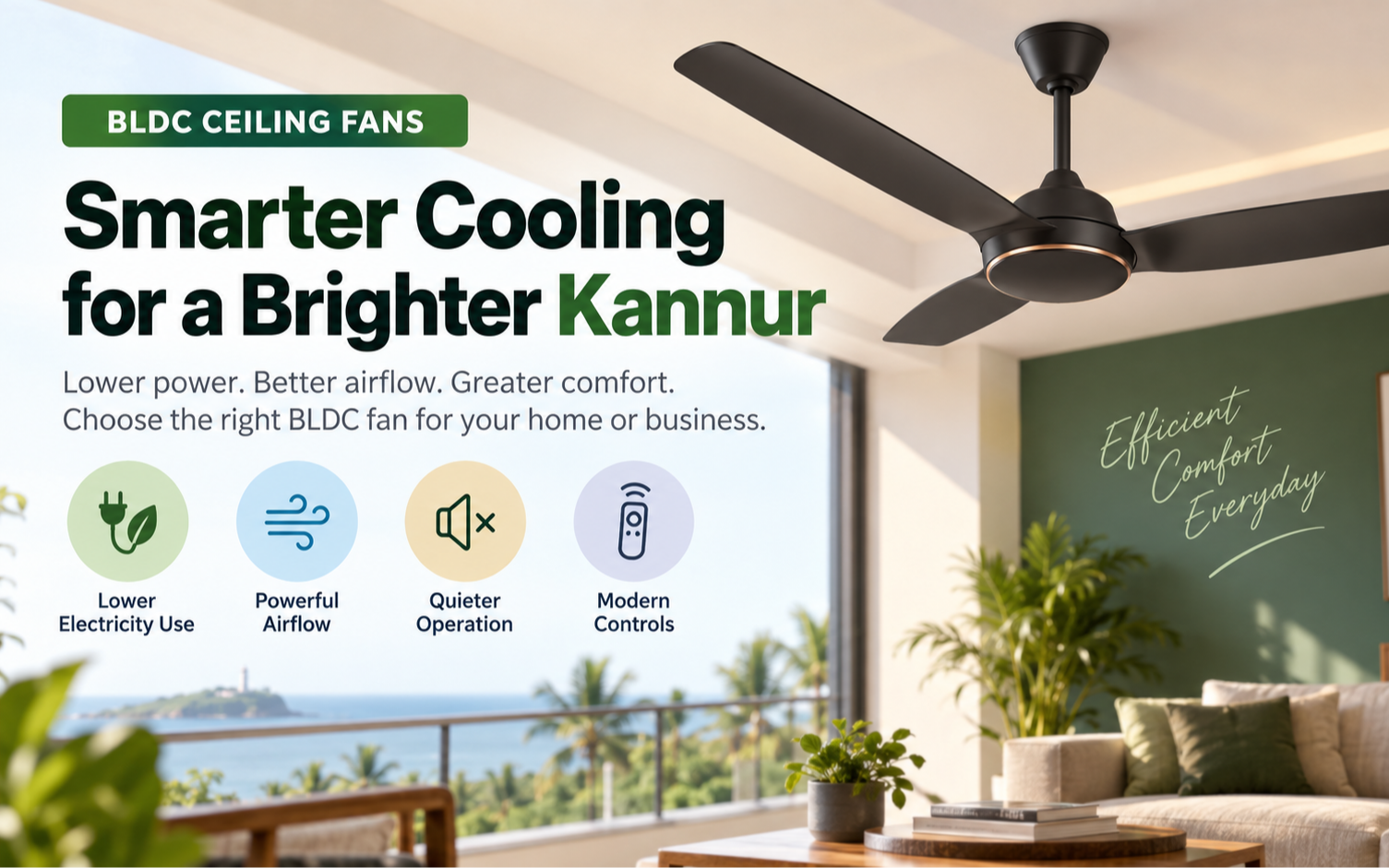
Best BLDC Fan Dealer in Kannur: Room Size, Airflow and Service Guide
The best BLDC fan dealer in Kannur should help you choose airflow, sweep, controls and service - not simply point to the fan with the largest discount. BLDC ceiling fans can substantially reduce motor power compared with many older conventional fans, especially in rooms where fans operate for long hours. The actual benefit depends on the exact model, speed, usage and electricity tariff, so compare verified specifications and calculate with your own routine.
Manufacturers such as Atomberg publish model-level information including wattage, air delivery, sweep, voltage range, controls and warranty. Those details demonstrate why buyers should compare exact models rather than treating every BLDC fan as identical. Basta Eco's BLDC fan page for Kannur provides a local route to discuss room fit and current availability.
Sweep is the diameter covered by the rotating blades, commonly shown in millimetres. A compact room, kitchen, balcony or passage may need a smaller sweep, while standard bedrooms and living areas commonly use larger sizes. Very large rooms may be better served by two fans placed correctly instead of one fan at the centre. Manufacturer room-size guidance is a starting point; furniture layout, ceiling height and the occupied zone also matter.
Measure room length and width, note the ceiling height and mark beams, lights, false-ceiling steps and wardrobes. The fan needs adequate clearance from walls and obstacles. The down rod should position it to deliver air effectively while maintaining safe clearance. If the ceiling is sloped, unusually high or false, discuss the mounting method before purchase.
A low watt figure is attractive only when the fan delivers suitable airflow. Review air delivery, commonly stated in cubic metres per minute, together with speed and sweep. Two fans using similar power can feel different because of blade design, speed, room geometry and placement. A showroom demonstration can help with controls and perceived sound, but room conditions will differ, so retain the official specification as the comparison basis.
Do not assume more RPM automatically means better comfort. A smaller fan may rotate faster while moving a different total volume of air. Compare within the size needed for the room. For bedrooms, balanced airflow and low unwanted noise may matter more than maximum boost speed. For a shop or waiting area, coverage and long operating hours may dominate.
Use the wattage difference between the present fan and the proposed model. Multiply it by daily operating hours and days, then divide by 1,000 to estimate monthly kilowatt-hours saved. Multiply by the relevant marginal electricity rate for an approximate cost difference. Example assumptions should never be presented as guaranteed savings because fan speed, season, tariff and actual hours vary.
Repeat the calculation for each high-use fan. Replacing one rarely used guest-room fan may produce a slow financial return, while several night-time fans may create a more visible difference. If the existing fan still works well, consider replacing units in phases as rooms are renovated or appliances reach the end of useful service.
Energy labels help consumers compare products in covered categories. Verify the label and model details rather than relying on a shelf sticker or a brand-wide claim. Record rated power and service value where shown. A star rating applies under standard test conditions and does not remove the need to compare airflow, size and use.
Ask whether the quoted model includes a remote, how many speed levels it offers, whether boost, sleep or timer modes are available, and whether smart control requires an app or internet connection. Confirm the operating voltage range from the current datasheet. Product families can contain multiple variants with different finishes, lights, controls and warranties.
BLDC fans often use electronic remotes instead of a traditional resistive wall regulator. Confirm the recommended wall-switch arrangement and whether the existing regulator should be bypassed or removed by a qualified person according to the manufacturer's guidance. Keep the wall isolator accessible. Label remotes by room and check the availability and cost of replacements.
In a bedroom, consider whether indicator lights can be dimmed or disabled. In homes with older residents, a simple remote with clear buttons may be better than app-only control. Smart features are valuable when they solve a routine problem; they should not make basic fan operation dependent on a phone.
Lower fan power can extend the useful runtime of a compatible inverter-and-battery system because fans often remain on throughout an outage. Estimate the combined watts of all fans, lights and electronics that will operate together. The inverter still needs sufficient continuous and surge capability for the complete essential-load circuit.
Do not infer that a fan will tolerate every waveform, voltage condition or wiring arrangement. Review product and inverter guidance. Basta Eco can coordinate efficient fans with stationary LFP battery and inverter planning. These home-energy batteries are for solar and backup, not electric-vehicle replacement.
High humidity, monsoon conditions and coastal exposure make correct indoor or covered-use selection important. A standard indoor ceiling fan should not be assumed suitable for direct rain or an exposed outdoor location. Ask for products intended for the actual environment. For kitchens and semi-open areas, discuss blade material, finish and cleaning requirements.
The ceiling hook or mounting point must be sound. Use the supplied or approved safety components, down rod and fasteners. After installation, check for abnormal wobble, rubbing, noise or heating and report concerns rather than attempting internal repairs. Disconnect power before external cleaning and follow the manual. Do not bend blades to correct balance.
Online competitor pages often emphasise a maximum savings percentage, smart functions and attractive finishes. Local dealer pages may emphasise address and stock. A professional choice needs both: model-level evidence and a support path close enough to be useful. Ask for a written quotation containing exact model, colour, sweep, quantity, price, taxes, delivery, installation and warranty.
For bedrooms, focus on quiet operation, timer usability and comfortable airflow over the sleeping area. For living rooms, consider coverage, design and interaction with lights or decorative ceilings. For kitchens and balconies, a smaller sweep may fit, but the location and exposure must be suitable. For shops, classrooms or offices, long operating hours make power and service especially important. A one-model-for-every-room order can be convenient but is not always optimal.
The best BLDC fan dealer in Kannur will measure before recommending, explain wattage alongside airflow, make warranty terms visible and support correct installation. The dealer should also be comfortable saying when an existing fan does not need immediate replacement. That honesty helps customers direct their budget to the rooms where efficiency and comfort will improve most.
Bring room dimensions, ceiling photographs, usage hours and current fan wattage if available when visiting Basta Eco Products Kannur LLP at Basta Tower, opposite Krishna Menon Women's College, Pallikkunnu. A small amount of preparation makes the comparison much more useful.
It depends on the old and new model wattages, speed and operating hours. Use exact rated inputs and your routine to estimate kilowatt-hours; do not rely on one universal percentage.
Room area, shape, ceiling height and occupied zone determine the answer. Standard rooms often use a 1200 mm class fan, but verify the manufacturer's guidance and site layout.
Many remote-controlled BLDC fans require a different arrangement. Follow the exact model's installation instructions and have wiring changes completed by a qualified person.
A lower-wattage fan can reduce the backup load and may extend runtime, but the result depends on the number of loads, battery capacity, inverter efficiency and system condition.
Confirm warranty duration, registration, onsite terms, complaint channel, coverage in your location, exclusions and the availability of remotes and electronic spare parts.
Energy-Efficient Home Upgrade Plan for Kannur: BLDC, Solar and LFP Backup
 December 24, 2026
December 21, 2026
December 18, 2026