Call us now: 90613 27222
Email: info@bastaeco.com
Best BLDC Fan Dealer in Kannur: Room Size, Airflow and Service Guide
Share this post:
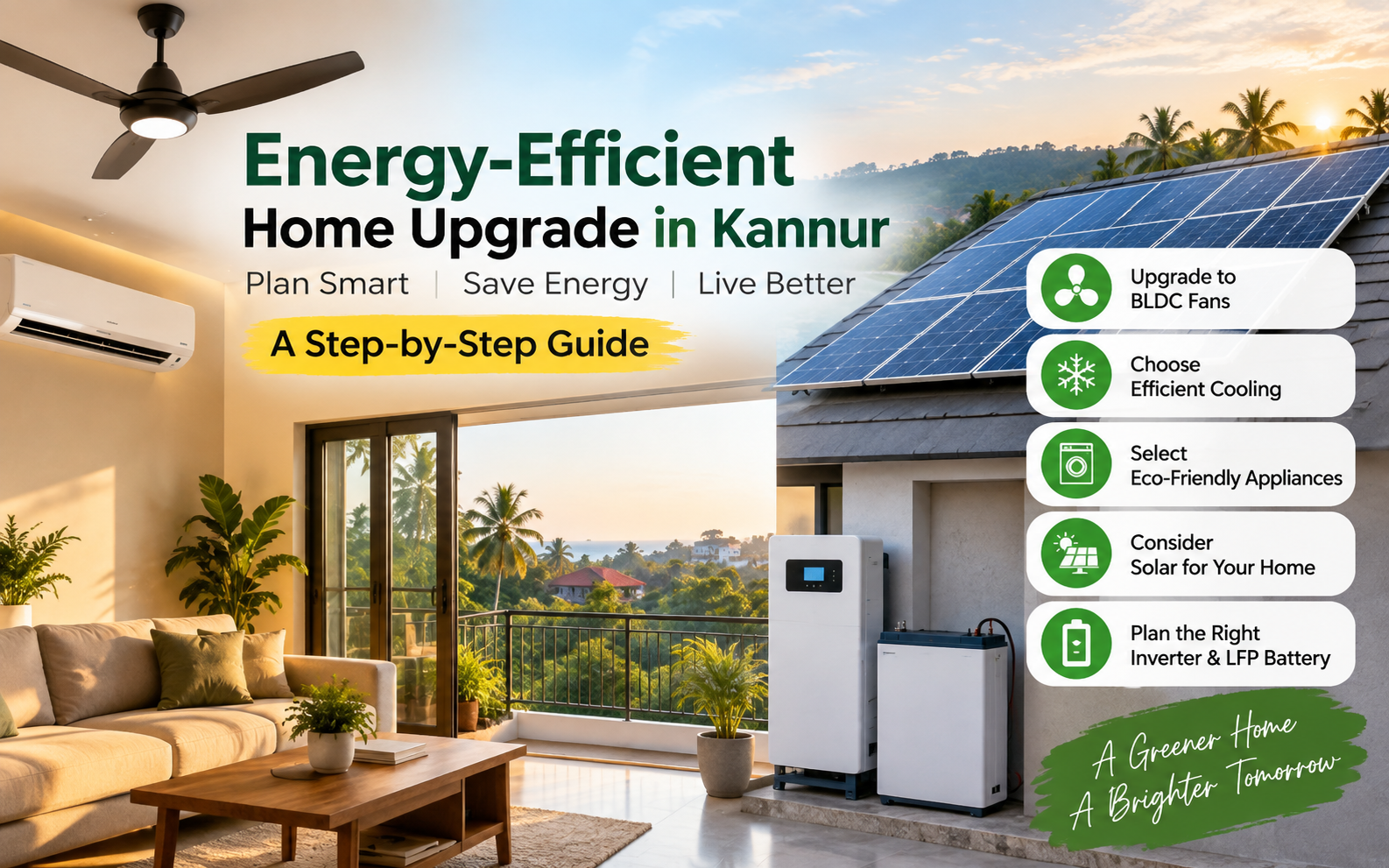
Energy-Efficient Home Upgrade Plan for Kannur: BLDC, Solar and LFP Backup
An energy-efficient home upgrade in Kannur works best as a sequence, not a shopping spree. Begin by measuring where electricity is used, improve long-hour appliances, correct avoidable cooling losses, and then size solar or backup for the remaining load. This approach can improve comfort, reduce waste and prevent customers from buying oversized systems. It also connects several common searches - BLDC fans, BLDC AC, eco-friendly appliances, solar, inverter and LFP battery - without pretending that one product solves every problem.
Basta Eco can help customers review these categories from one local point of contact. Its stationary LFP batteries are intended for compatible solar and inverter systems, not EV replacement. Complete electric scooters belong to a separate mobility decision and authorised vehicle support path. Keeping those applications clear is an important part of professional advice.
Collect several recent electricity bills and note seasonal changes. List major appliances, rated wattages and approximate daily hours. Separate continuous or long-hour loads from short-use loads. If the home has an inverter, identify which circuits are already backed up and record the exact inverter model and battery configuration.
Calculate approximate monthly energy for each item as watts multiplied by daily hours and days, divided by 1,000. The result will not exactly reproduce the utility bill because appliances cycle and ratings represent defined conditions, but it helps rank opportunities. Where uncertainty is high, a plug-in meter or professional monitoring can provide better data for suitable loads.
Clean AC filters at recommended intervals, keep cooled-room doors and windows closed, set sensible schedules, switch off unused equipment and repair obvious air leakage. Check refrigerator seals and allow ventilation around heat-rejecting appliances as instructed. Use timers or automation only when they simplify habits. These measures cost less than new equipment and may change the size of later upgrades.
For a home office or entertainment area, reduce standby use where safe and convenient. For pumps, investigate leaks, tank overflow and unnecessary cycling. Never compromise safety or essential ventilation to save power. Efficiency means delivering the required service with less waste, not simply turning everything off.
Fans are a logical early target because several may run for many hours. Compare the existing fan's wattage with a suitable BLDC model while also checking sweep, air delivery, speed, noise, remote functions and warranty. Choose for each room rather than ordering one size for the whole property. Smaller spaces and large living areas can require different sweeps or quantities.
Estimate the saving using the wattage difference and real operating hours. Lower fan demand can also improve backup duration. Visit the Basta Eco BLDC fan guide to prepare room dimensions and ceiling information before requesting a quote.
Air-conditioner capacity should account for area, ceiling height, roof and wall exposure, windows, shade, occupancy and heat-producing equipment. An oversized or undersized system can undermine comfort and value. Compare current model-specific energy information for equivalent capacities and ask the dealer to document sizing assumptions.
Installation affects real performance. Plan indoor airflow, outdoor ventilation, condensate drainage, pipe route, electrical supply and service access. In humid, monsoon-prone conditions, drainage and filter care deserve particular attention. If solar-assisted or BLDC cooling is being considered, ask for the exact system architecture and behaviour during low sun, at night and during an outage. The BLDC AC dealer page for Kannur outlines the right starting questions.
Review products that are old, unreliable, heavily used or already due for purchase. For each option, compare capacity, output, rated input, applicable energy label, maintenance, consumables, warranty and service. A low-watt device that cannot perform the required task is not efficient in practice. Likewise, premium connectivity adds value only if the household will use it.
For water purifiers, start with water source and appropriate treatment rather than motor technology. For kitchen appliances, consider batch size, safety, cleaning and parts. For table or pedestal fans, examine stability, airflow and placement. Basta Eco's BLDC home appliances selection can be reviewed as part of this room-by-room plan.
Solar feasibility depends on roof rights, usable unshaded area, orientation, structure, cable route, electrical system, daytime consumption and applicable utility process. On-grid solar is generally focused on offsetting eligible consumption and should not automatically be assumed to operate during a grid failure. A hybrid system can provide more functions when designed with compatible storage and protected loads.
Request a site survey and a proposal with exact module and inverter models, array layout, mounting, protections, earthing, monitoring, installation, approvals or exclusions, warranties and generation assumptions. Compare complete scope rather than a single per-kilowatt number. Any saving or payback figure should state tariff, consumption, degradation, maintenance and financing assumptions.
List what must run during an outage and for how long. Add simultaneous running watts and account for starting demand. The inverter must meet power and surge requirements, while the battery must provide usable energy within its current and operating limits. A labelled essential-load circuit usually produces a more predictable result than attempting to back up every appliance.
Basta Eco provides LFP batteries for solar and inverter backup in Kannur. Confirm battery voltage, charging profile, communication and approved inverter compatibility. These stationary batteries are not intended as loose traction batteries for electric scooters or other EVs. Do not mix components based only on capacity or connector appearance.
If fuel use is another priority, evaluate a complete electric scooter using daily distance, route, charging location, range reserve, comfort, warranty and service. Take a test ride and request an itemised on-road quotation. Follow the vehicle manufacturer's process for traction-battery service. Home solar and efficient appliances may influence household energy use, but they do not make a stationary battery suitable for a vehicle.
The timing can change according to budget and urgency. An outage problem may bring backup forward; a failed AC may require immediate replacement. The principle is to use the best available load information at each decision.
Give every dealer the same room data, load list, operating hours and required scope. Require exact models and itemised installation. Compare warranty, commissioning, monitoring, exclusions, maintenance and service responsibility. For energy calculations, make vendors use the same tariff and usage assumptions. This turns competing marketing language into comparable proposals.
Ask which results are estimates and which are product specifications. Retain invoices, serial numbers, label photographs, manuals, commissioning records and warranty registration. Documentation is part of the product because it supports maintenance and future troubleshooting.
Compare similar seasons and account for changes in occupancy, weather and operating hours. Evaluate comfort, noise, backup reliability and service along with electricity use. A bill may rise after adding an AC even when the AC is efficient; the relevant question is whether the new service is being delivered efficiently. Solar output should be compared with the proposal assumptions and monitoring data, not with a perfect fixed number.
A durable upgrade plan is conservative about promises and specific about equipment. It prioritises the load, matches components, installs them correctly and keeps a local service route. That is how Kannur homes can turn energy-efficient and eco-friendly intentions into practical results.
Usually assess and reduce avoidable loads first, because a lower demand can improve solar and backup sizing. Urgency, roof opportunity and budget may change the sequence.
It depends on existing wattage and hours. Low-cost corrections and heavily used inefficient fans often deserve early attention, but calculate using your home data.
Not necessarily. On-grid and hybrid systems serve different goals. If outage backup is required, discuss a compatible hybrid or backup architecture and protected loads.
No. Basta Eco's LFP batteries are for compatible stationary solar and inverter applications, not EV traction replacement. Use authorised vehicle service for scooter batteries.
Bring several bills, room and roof photographs, major appliance wattages and hours, desired backup duration, existing inverter details and the goals you want to prioritise.
BGauss C12 MaxR: New Electric Scooter Features and a Practical Buyer Guide
 December 24, 2026
December 21, 2026
December 18, 2026