Call us now: 90613 27222
Email: info@bastaeco.com
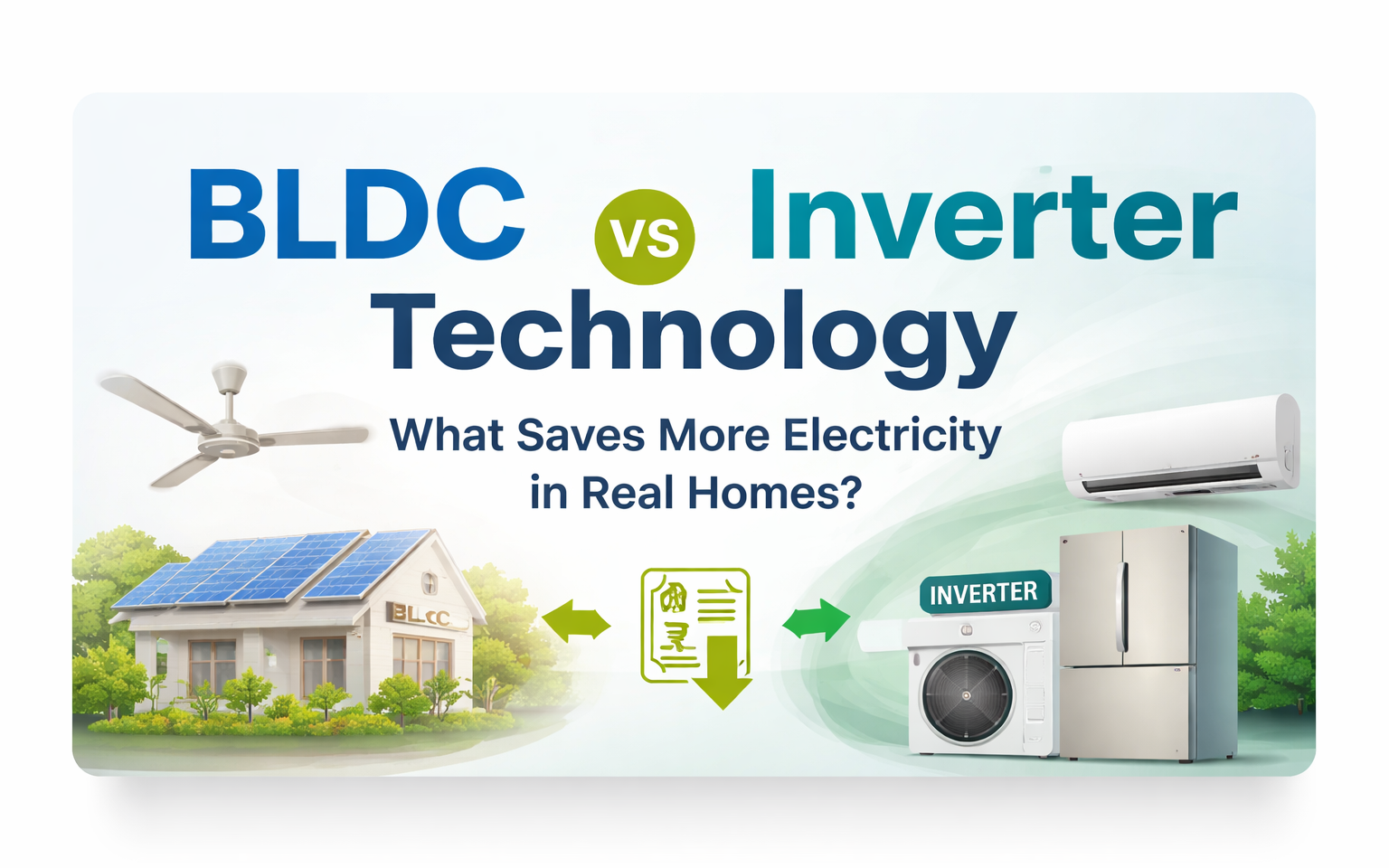
BLDC vs Inverter Technology: What Saves More Electricity in Real Homes?
As electricity costs continue to rise in Kerala, homeowners are actively searching for smarter ways to reduce their power consumption without compromising comfort. Two technologies often discussed in this context are BLDC (Brushless Direct Current) and Inverter technology. Both promise energy efficiency—but which one actually saves more electricity in real homes?
This guide breaks down the differences, real-world performance, and how combining both can maximize savings.
BLDC (Brushless Direct Current) motors use advanced electronic controllers instead of traditional brushes and commutators. This reduces friction, heat loss, and energy wastage.
Common BLDC appliances:
Key advantage: Extremely low power consumption.
Inverter technology is widely used in appliances like air conditioners and refrigerators. Instead of switching on/off repeatedly, inverter systems regulate motor speed based on demand.
Common inverter appliances:
Key advantage: Maintains consistent performance with reduced energy spikes.
| Feature | BLDC Technology | Inverter Technology |
|---|---|---|
| Motor Type | DC motor | AC motor with variable speed |
| Energy Efficiency | Very high | High |
| Power Consumption | Extremely low | Moderate savings |
| Speed Control | Precise & stable | Dynamic adjustment |
| Ideal For | Fans, small appliances | ACs, heavy appliances |
| Initial Cost | Slightly higher | Higher |
Let’s look at actual usage scenarios in a Kerala household:
Daily usage: 10 hours
Monthly savings: ~14–18 units per fan
For a home with 4 fans, savings can exceed ?400–?600/month
Monthly savings: ?800–?1500 depending on usage
BLDC appliances consume up to 60–70% less electricity compared to conventional alternatives. For devices like fans that run for long hours, BLDC delivers massive savings.
For high-power appliances like ACs, inverter technology significantly reduces energy wastage compared to traditional models.
This isn’t a competition—it’s a combination strategy.
Use BLDC for:
Use Inverter technology for:
Together, they can reduce your total electricity bill by 40%–70%
When you integrate solar power + BLDC appliances + inverter ACs, the savings multiply.
This combination is ideal for Kerala homes, where electricity usage is high due to climate conditions.
| Appliance Type | Technology | Monthly Savings |
|---|---|---|
| Fans (4 units) | BLDC | ?400–?600 |
| AC (1 unit) | Inverter | ?800–?1500 |
| Refrigerator | Inverter | ?200–?400 |
Total Savings: ?1400 to ?2500 per month
At Basta Eco Products, we specialize in delivering complete energy-saving solutions tailored for Kerala homes:
We help you analyze your current electricity usage and design a system that maximizes savings.
Not exactly. BLDC is more efficient for small appliances, while inverter technology is better for high-power appliances like ACs.
Yes. In fact, BLDC appliances consume less power, so they significantly increase backup time.
Absolutely. The higher upfront cost is usually recovered within 6–12 months through electricity savings.
Yes. It can reduce consumption by 30–40% compared to non-inverter ACs.
A mix of solar + BLDC appliances + inverter ACs offers the highest efficiency and lowest electricity bills.
If your goal is to reduce electricity bills in real homes, the smartest approach is not choosing between BLDC and inverter technology—but using both strategically.
BLDC = Maximum efficiency for everyday appliances
Inverter = Smart energy control for heavy appliances
Combine them with solar, and you move closer to energy independence.
BGauss RUV 350 Electric Scooter: The Ultimate Kerala-Focused Guide (2026)
 December 24, 2026
December 21, 2026
December 18, 2026