Call us now: 90613 27222
Email: info@bastaeco.com
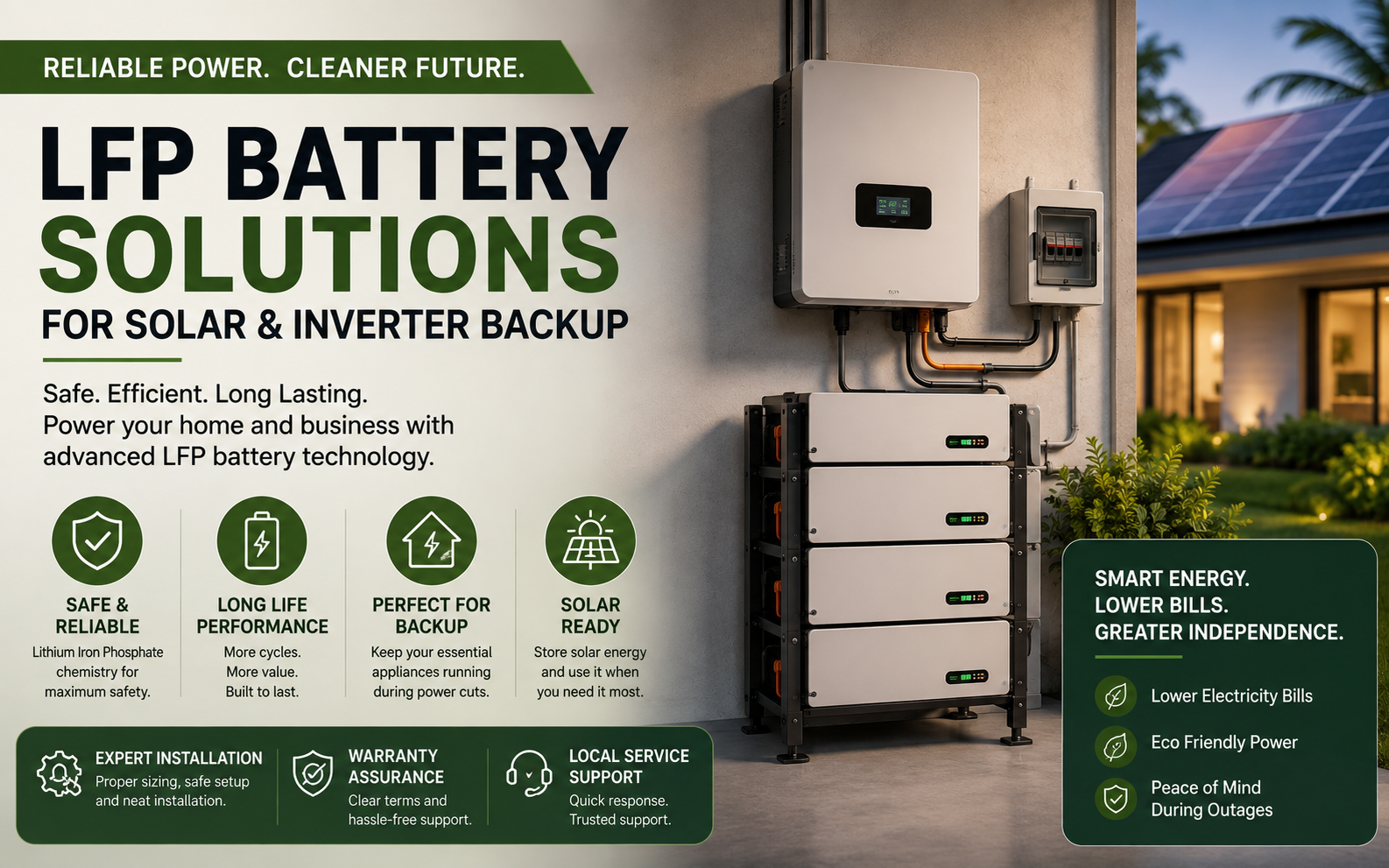
Best LFP Battery Dealer in Kannur for Solar and Inverter Backup
Customers searching for the best LFP battery dealer in Kannur need more than a battery price. A stationary battery must be compatible with the inverter or solar system, sized for the required loads and runtime, installed in a suitable location, and supported by clear warranty terms. Basta Eco supplies LFP battery solutions for solar energy storage and inverter backup. It does not sell standalone EV traction or replacement batteries.
LFP means lithium iron phosphate, a lithium-ion chemistry used in many stationary storage products. Chemistry alone does not define a complete system. The pack's nominal voltage, usable capacity, continuous and surge limits, battery-management system, communication method, enclosure and approved charging conditions all matter. A professional dealer checks these details before recommending a product.
Write down essential devices and their rated watts: lights, BLDC fans, router, television, computer, security system, refrigerator or selected business equipment. Decide which will run at the same time. Then choose the required backup duration. Multiplying watts by hours gives a first estimate in watt-hours, but the final design must also consider inverter efficiency, battery usable capacity, peak demand, starting loads and the manufacturer's operating limits.
A refrigerator, pump or motor can have a starting demand above its normal running value. Air conditioners and heating appliances can consume enough power to change the system size significantly. Rather than adding every circuit to backup, create a protected essential-load group. This often produces a clearer, more economical system and avoids accidental overload during an outage.
Battery products may be described in ampere-hours, kilowatt-hours or both. Ampere-hours cannot be compared meaningfully without voltage. A 100 Ah battery at one nominal voltage stores a different amount of energy from 100 Ah at another. For an initial comparison, nominal energy is voltage multiplied by ampere-hours, but available energy depends on the battery's specified usable range and operating conditions.
Do not assume the entire nameplate capacity should be used on every cycle. Refer to the current datasheet for usable capacity, recommended depth of discharge, current limits, temperature range and cycle-life test conditions. A cycle-life figure is not a simple promise that every installation will deliver that exact number; temperature, charge rate, discharge rate, depth of discharge, settings and calendar time influence service life.
The inverter or power-conversion equipment must support the proposed battery voltage and charging profile. Some systems also require communication between the inverter and the battery-management system. Confirm supported models or approved settings with current manufacturer documentation. A connector that physically fits does not prove electrical or software compatibility.
If an existing inverter is being retained, record its brand, exact model, rated power, supported battery voltage, software version where relevant and present wiring. Share photographs of its label and installation. The dealer should state in writing whether it is compatible, whether settings or accessories are required, and which party will commission the system. If compatibility cannot be verified, a matched inverter-and-battery proposal may be safer than an improvised combination.
In a backup-only application, the battery may remain charged until the grid fails, depending on system settings. In a solar application, it may charge from solar and discharge according to time, load, state of charge and programmed priorities. A hybrid design may decide when to use solar, battery and grid. Ask for a plain-language explanation of the daily energy flow and what changes during an outage.
Solar panels do not guarantee that all appliances can operate during a power cut. The protected-load output, inverter capacity, available solar at that moment and battery limits still apply. Likewise, adding a battery to an on-grid system may require a different or additional compatible power-conversion arrangement. Review the whole architecture rather than buying storage as an isolated accessory.
Follow the manufacturer's requirements for orientation, clearances, mounting, ventilation, temperature, moisture protection and access. The location should be dry, secure from accidental impact, away from direct heat and accessible for inspection. It should not obstruct exits or be placed where water can collect. Electrical isolation, cable sizing, over-current protection, earthing and labelling should be included in the design.
Do not open the pack, bypass its battery-management system or modify connectors. If the system reports faults, unusual heat, odour, swelling, physical damage or repeated shutdowns, isolate it only as instructed and contact qualified support. Keep children and unauthorised persons away from the equipment. Installation and service should follow applicable manufacturer instructions and electrical requirements.
Some competitor pages combine EV batteries, home backup, solar products and many chemistries in one broad catalogue. Breadth can be useful, but it can also blur application boundaries. Basta Eco's positioning is deliberately clearer: its LFP battery solutions in Kannur are for compatible solar and inverter systems, while complete scooters are handled as vehicles through their own dealership and authorised support process.
Read the product warranty rather than relying on a verbal number of years. Check registration requirements, installation conditions, approved inverter pairings, operating limits, proof needed for a claim, transport responsibility and exclusions for water, impact, tampering, unsuitable settings or external electrical events. Ask whether onsite attendance is included and what diagnostic data may be required.
Retain the invoice, serial-number photograph, commissioning record, settings, monitoring credentials and manuals. If the system is connected to solar, keep the array and inverter documentation together. These records help technicians understand the original configuration and can shorten future support.
Backup time is not a fixed property of the battery alone. It changes with total load, inverter efficiency, battery state, configured reserve, temperature and battery condition. A dealer can provide an estimate using declared assumptions. Ask for at least two cases: the normal essential-load scenario and a heavier scenario. This shows which appliance causes the largest reduction in runtime.
Efficient loads help. Replacing high-use fans with suitable BLDC models, using efficient lighting and switching off nonessential circuits can extend useful backup without increasing battery capacity. It is usually better to improve the load plan before paying for more storage.
Bring a recent bill, appliance list, desired backup hours, photographs of the inverter label and installation, and details of any solar system. Ask: Which exact battery model is proposed? What is its nominal and usable capacity? Which inverter documentation confirms compatibility? What loads are included? What protections and labour are included? Who commissions the system? What does the warranty exclude? How is a fault reported?
The best LFP battery dealer in Kannur will answer those questions in a way you can review later. Accurate sizing, verified compatibility and local accountability create more value than a low standalone battery price.
No. Basta Eco's standalone LFP batteries are for compatible solar storage and inverter backup, not EV traction or replacement applications.
It depends on simultaneous essential load, required hours, surge demand, inverter efficiency and the product's usable capacity. A load-based calculation is required.
Only after confirming voltage, charging profile, current limits and any communication requirement with current manufacturer documentation. Physical connection alone is not enough.
A suitably designed system may support selected AC loads, but capacity, surge, runtime and cost must be assessed. Do not add an AC to an essential-load circuit without validation.
It should list exact battery and inverter models, capacities, cables, protection, mounting, installation, commissioning, monitoring, taxes, warranty, exclusions and support process.
Best LFP Battery and Inverter Dealer: Compatibility and Sizing Guide
 December 24, 2026
December 21, 2026
December 18, 2026