Call us now: 90613 27222
Email: info@bastaeco.com
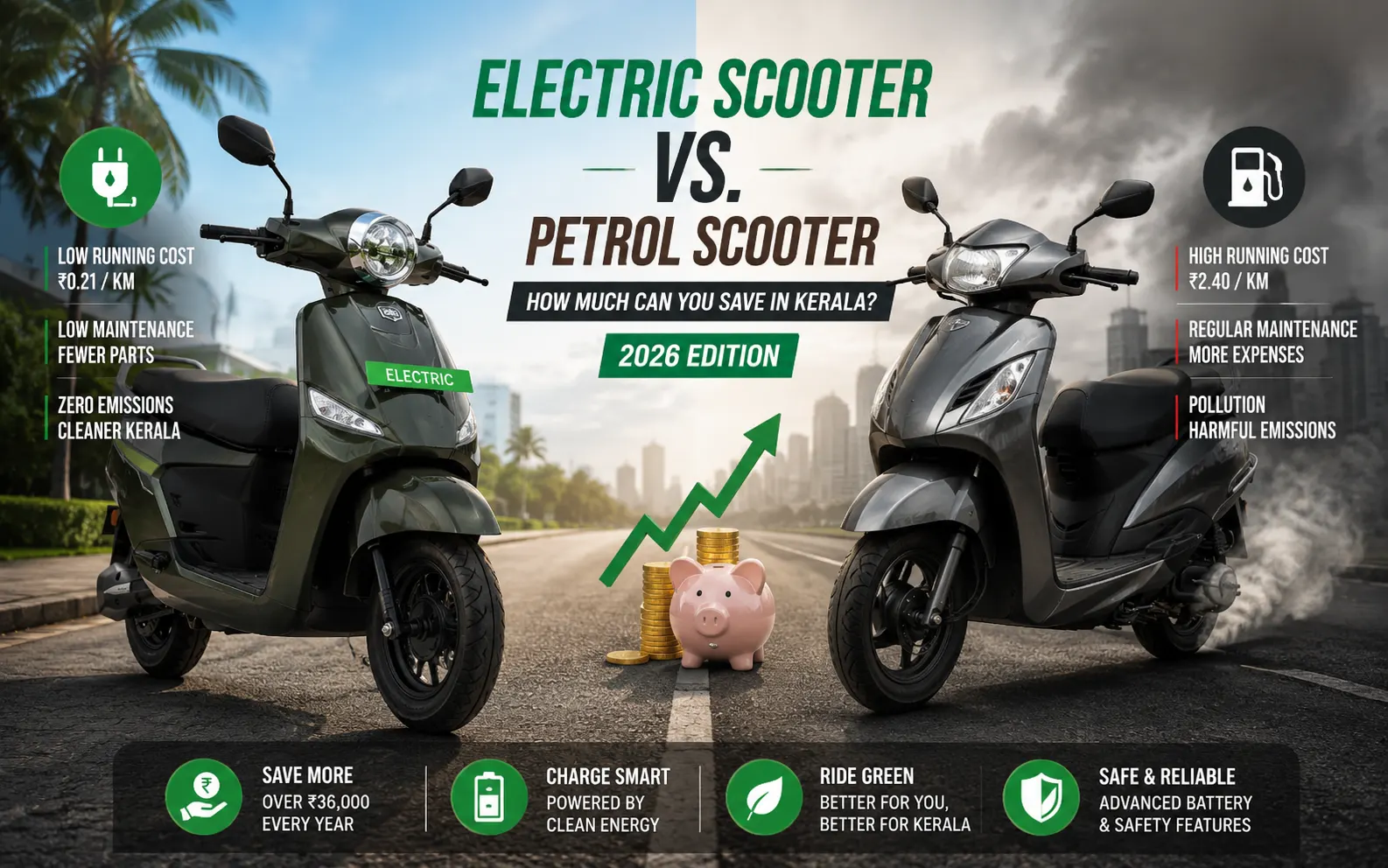
Electric Scooter vs. Petrol Scooter: How Much Can You Save in Kerala (2026 Edition)?
Share this post:
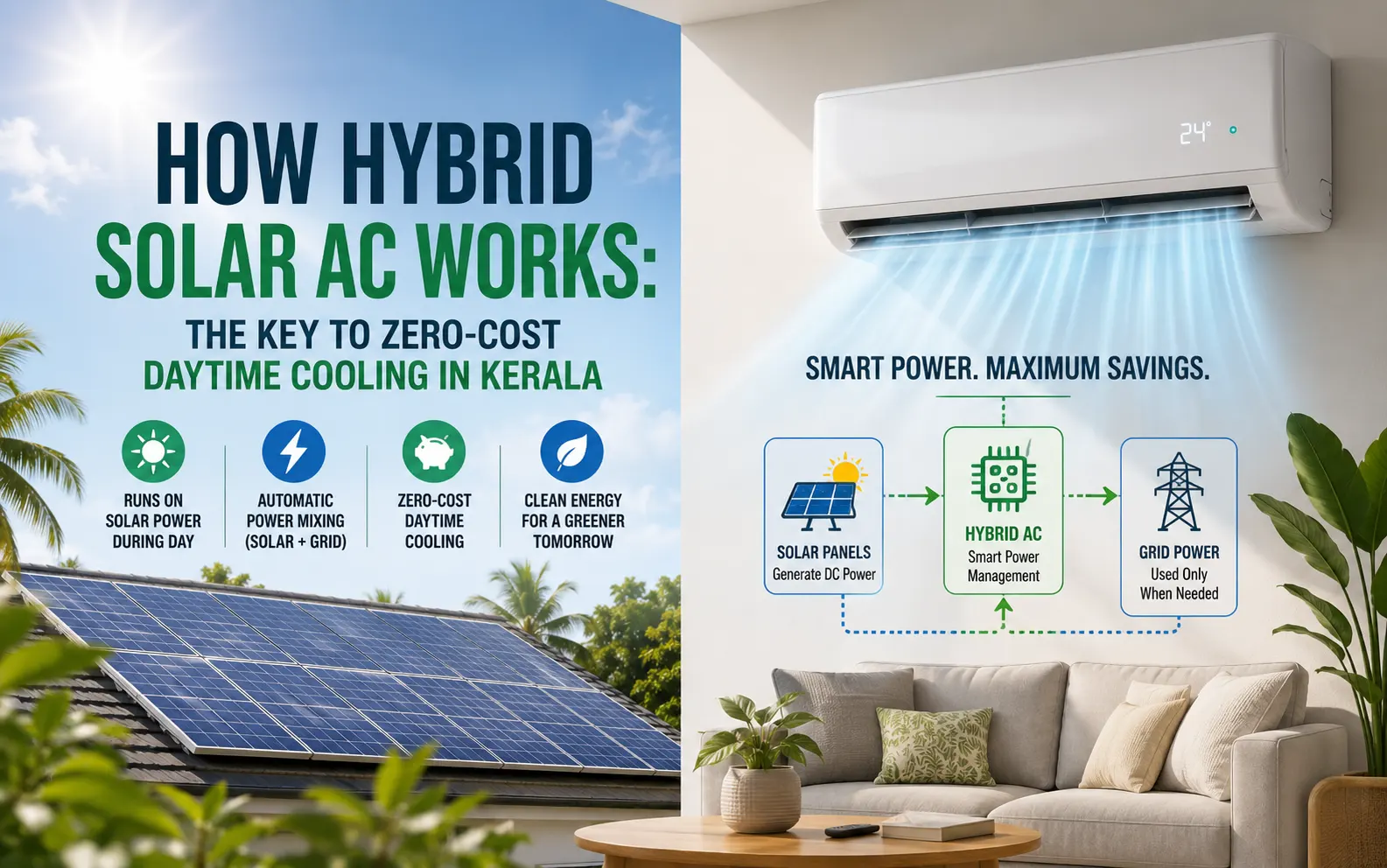
How Hybrid Solar AC Works: The Key to Zero-Cost Daytime Cooling in Kerala
Kerala's tropical climate is known for its high humidity and soaring temperatures, making air conditioning a virtual necessity for homes, offices, and shops. However, running a standard air conditioner for several hours a day can cause your electricity bills to skyrocket, often pushing your consumption into expensive tariff slabs. The solution to this problem lies in one of the most innovative renewable energy technologies of recent years: the Solar Hybrid Inverter Air Conditioner. Brands like Global Cool have pioneered this technology, offering systems that run directly on solar power during the day. But how exactly does a hybrid solar AC work, and how can it help you achieve zero-cost daytime cooling? In this detailed technical guide, we break down the engineering behind solar hybrid ACs, explain the power mixing process, and analyze the financial benefits of upgrading your cooling system in Kerala.
To understand a solar hybrid AC, we must first look at how standard air conditioners operate. Traditional ACs run on Alternating Current (AC) electricity drawn from the main grid. When you turn on a traditional AC, it pulls a heavy load from your meter, especially when starting the compressor. Even modern inverter ACs, which are more efficient, rely entirely on grid power.
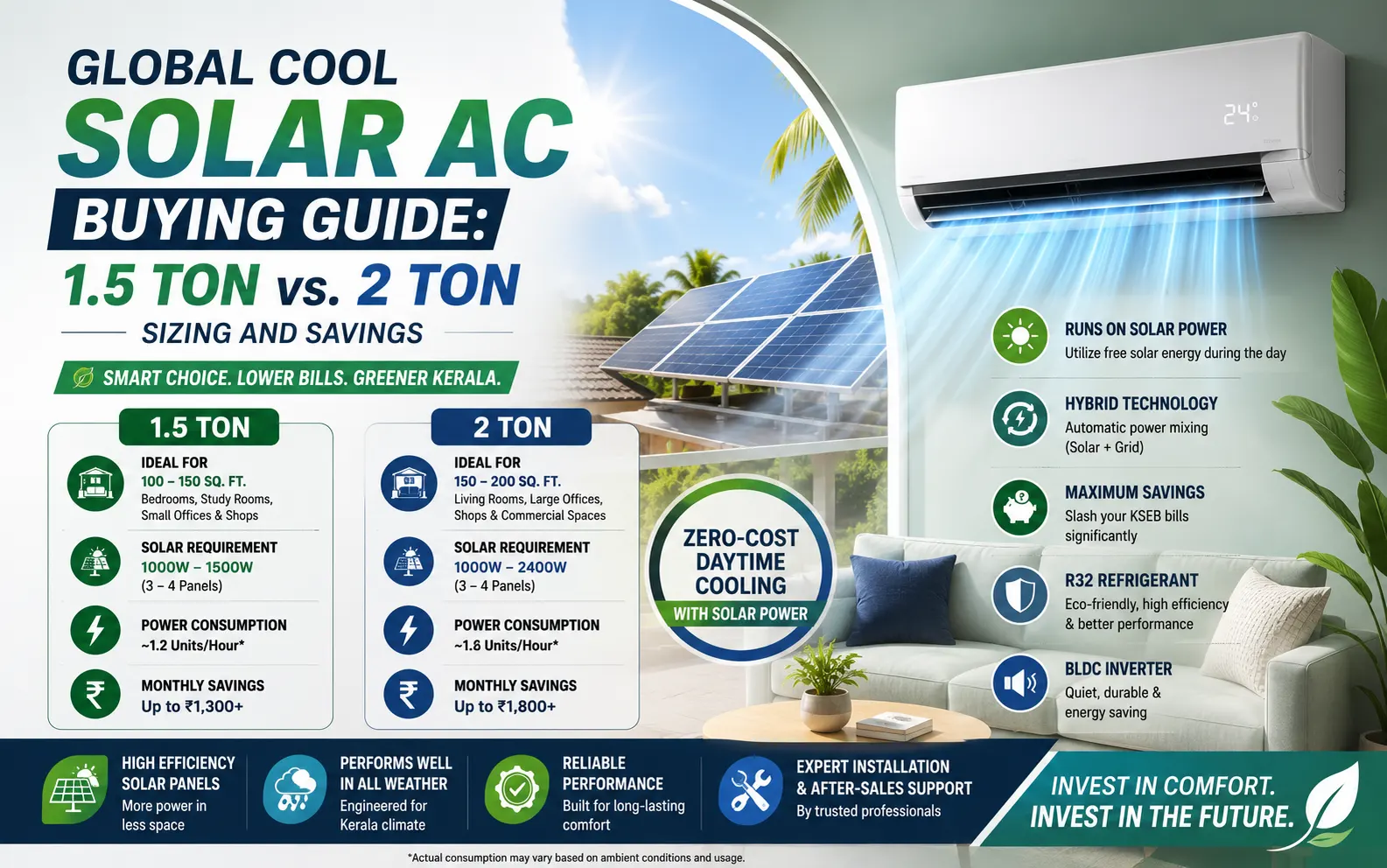
A Solar Hybrid Inverter AC is a specialized cooling system engineered to accept two sources of power simultaneously: Direct Current (DC) power directly from solar panels and Alternating Current (AC) power from the utility grid. The key feature of a hybrid AC is its ability to run directly on DC solar power without requiring expensive batteries, charge controllers, or inverters to convert DC to AC. By eliminating these middle components, the system operates at maximum electrical efficiency and significantly lower installation costs.
The magic of the solar hybrid AC lies in its internal power management circuitry. Let's trace how power flows through the system during a typical day:
A. Peak Sunlight Hours (10 AM to 4 PM):
During a bright, sunny day, the solar panels installed on your rooftop generate clean DC electricity. The solar DC power flows directly into the outdoor unit of the hybrid AC. The internal controller detects that the solar generation is sufficient to run the compressor and the indoor unit. In this scenario, the AC draws 100% of its power from the solar panels. Your KSEB electricity meter remains completely stationary, giving you 100% free, zero-cost cooling while the sun is shining brightest.
B. Partly Cloudy or Overcast Conditions:
If a cloud passes over the solar panels, their power output drops temporarily. In a standard solar setup, this drop in generation could cause the system to trip or shut down. However, the hybrid AC's controller is designed to handle this seamlessly. It automatically mixes the power sources: if the AC requires 1000W of power, but the solar panels are generating only 700W due to clouds, the controller draws the remaining 300W from the utility grid. This transition is completely automatic and imperceptible, ensuring uninterrupted cooling comfort.
C. Nighttime Operation:
After sunset, when solar panels generate zero power, the hybrid AC operates exactly like a standard, ultra-efficient 5-star inverter air conditioner. It draws 100% of its power from the grid, utilizing advanced BLDC compressor technology to keep electricity consumption to a minimum.
One of the main challenges of solar energy is storage. Batteries are expensive, require maintenance, and have a limited lifespan. However, air conditioning presents the perfect solution to this challenge. Air conditioners are used most heavily during the hottest hours of the day (late morning to afternoon)—which matches perfectly with the peak generation hours of solar panels!
By using a hybrid solar AC, you bypass the need for a battery storage system. The solar energy is consumed immediately as it is generated, converting sunlight directly into cool air. This direct consumption model eliminates the conversion losses associated with storing power in batteries and returning it to the grid, making it the most efficient way to utilize solar energy for home cooling.
To get the best performance from your hybrid solar AC, it must be paired with the correct number of solar panels. Sizing depends on the capacity of the AC:
At Basta Eco, we recommend using monocrystalline half-cut solar panels, which offer higher efficiency and perform exceptionally well under diffuse sunlight (such as on cloudy monsoon days in Kerala).
How much money can you save by installing a solar hybrid AC? Let's analyze the financial savings for a household in Kerala. In Kerala, KSEB uses a telescopic tariff structure where the cost per unit increases as your total monthly consumption increases. Let's assume running a standard AC pushes your bi-monthly consumption from 400 units to 650 units, placing you in the highest tariff slab where each unit costs Rs. 8.50.
A standard 1.5 Ton AC runs for 6 hours during the day, consuming approximately 7.2 units of electricity daily (1.2 kWh per hour). Over a month, this adds up to 216 units. Let's compare the costs:
| Expense Parameter | Standard Inverter AC | Global Cool Hybrid Solar AC | Monthly Savings | Annual Savings (8 Sunny Months) |
|---|---|---|---|---|
| Daytime Grid Consumption (Monthly) | 216 Units | 0 Units (runs on solar) | 216 Units Saved | 1,728 Units Saved |
| Cost per Unit (High Slab) | Rs. 8.50 | - | - | - |
| Monthly Running Cost | Rs. 1,836 | Rs. 0 | Rs. 1,836 | - |
| Annual Running Cost | Rs. 14,688 | Rs. 0 | - | Rs. 14,688 |
An annual saving of Rs. 14,688 from just one appliance is massive. Over the typical 10-year lifespan of the air conditioner, your total savings will exceed Rs. 1.4 Lakhs! Furthermore, because the hybrid AC reduces your overall consumption, it can drop your entire household into a lower, cheaper tariff slab, saving you additional money on your lights, fans, and refrigerator.
Since solar panels have no moving parts, they are incredibly durable and require almost zero maintenance. They are designed to withstand heavy rains, wind, and coastal humidity, with most panels carrying a performance warranty of 25 years. The hybrid AC unit itself requires the same maintenance as a standard AC: regular cleaning of the air filters every few weeks and an annual service by a professional technician to check refrigerant levels and clean the condenser coils.
A Solar Hybrid Inverter AC is the perfect technological solution for Kerala's climate. It matches your heaviest cooling demand with the peak generation of the sun, allowing you to enjoy air conditioning throughout the afternoon without worrying about your electricity bill. By eliminating batteries, it offers a highly affordable, efficient, and durable path to energy independence.
Ready to experience zero-cost cooling? Explore our advanced range of hybrid solar cooling units on our Solar & BLDC Air Conditioners Page or find the perfect solar panels to power your home in our Solar Panels Collection. Contact Basta Eco in Kannur today for a free site assessment and quote!