Call us now: 90613 27222
Email: info@bastaeco.com
Electric Scooter vs. Petrol Scooter: How Much Can You Save in Kerala (2026 Edition)?
With global energy markets experiencing volatility and environmental awareness reaching an all-time high, commuters across Kerala are asking a fundamental question: Is it time to ditch the petrol scooter and switch to electric? In 2026, petrol prices in Kerala continue to hover around Rs. 105 to Rs. 110 per liter, placing a heavy financial burden on middle-class households. On the other hand, the cost of electricity remains relatively stable, and the state government continues to promote renewable energy adoption. In this comprehensive guide, we perform an in-depth comparison between electric scooters and traditional petrol scooters. We analyze running costs, maintenance expenses, environmental footprints, and the real payback period, showing you exactly how much money you can save by going electric in Kerala today.
The most immediate and visible difference between a petrol and an electric scooter is the daily running cost. Let's break down the math using realistic averages for both types of vehicles in Kerala.
A. Traditional Petrol Scooter:
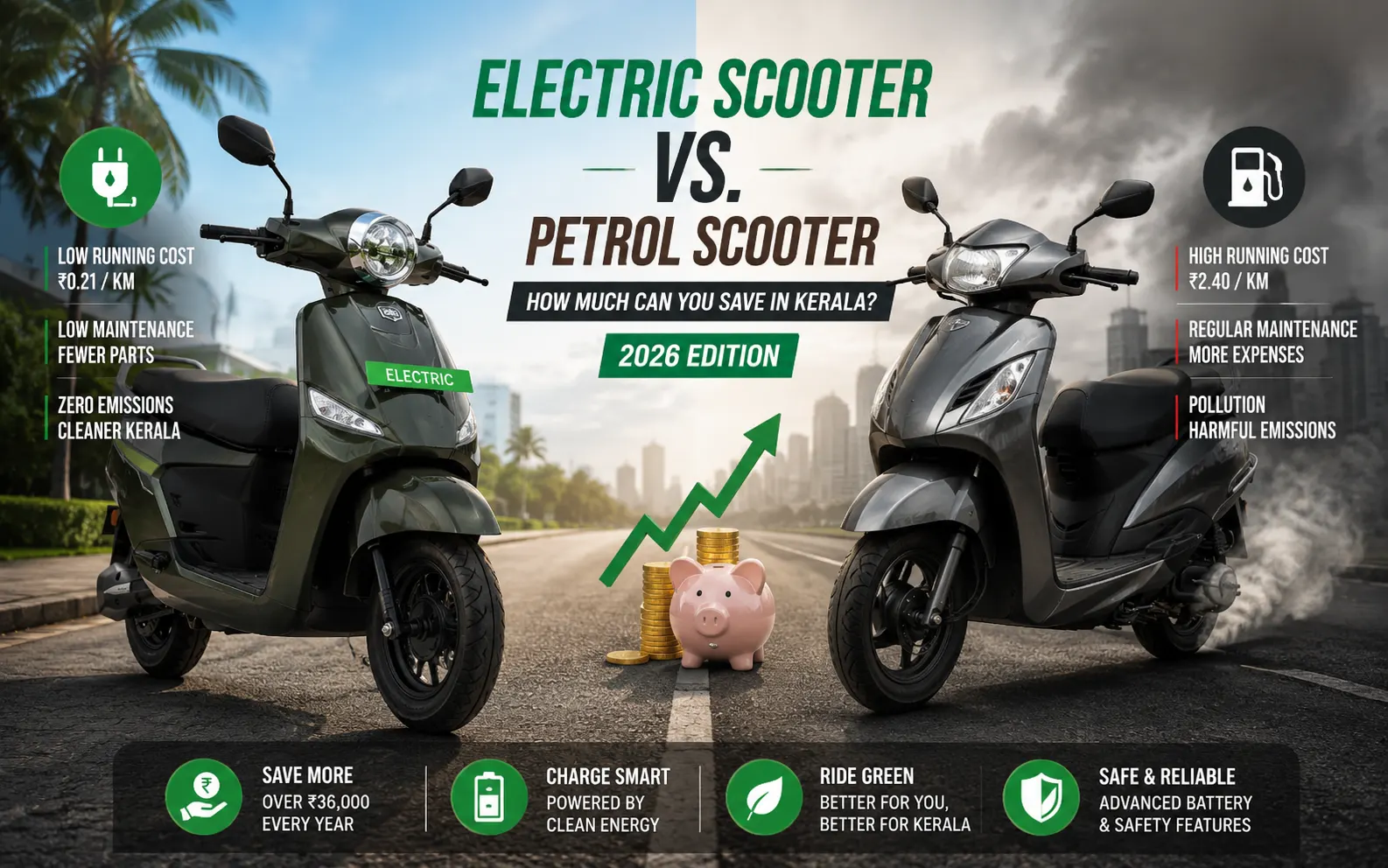
A typical 110cc or 125cc petrol scooter on Kerala's roads delivers a real-world fuel economy of about 45 kilometers per liter (km/l), especially when accounting for frequent stops in traffic and hilly terrains. At a price of Rs. 108 per liter, the running cost is:Rs. 108 / 45 km = Rs. 2.40 per kilometer.
B. Modern Electric Scooter:
A standard electric scooter, such as the BGauss BG RUV 350 or BG Max C12, features a battery capacity of around 3 kWh, which provides a real-world range of approximately 100 km. Fully charging a 3 kWh battery from 0 to 100% consumes roughly 3 units of electricity from your home meter. In Kerala, under the KSEB telescopic tariff, the average cost per unit for domestic consumers is around Rs. 7. Therefore, a full charge costs:3 units x Rs. 7 = Rs. 21.
Since a full charge gives 100 km of range, the running cost is:Rs. 21 / 100 km = Rs. 0.21 (21 paise) per kilometer.
The Verdict on Running Costs:
The electric scooter is over 11 times cheaper to run than a petrol scooter. You can ride 11 kilometers on an electric scooter for the same cost as riding a single kilometer on a petrol-powered two-wheeler!
Many buyers overlook the long-term cost of keeping a vehicle running. Petrol scooters are complex machines with hundreds of moving parts. They require regular servicing every 2,500 to 3,000 km to ensure reliability and safety. Standard maintenance items for petrol scooters include:
Each service typically costs between Rs. 1,000 and Rs. 2,000, including labor. Over a distance of 10,000 km per year, this adds up to Rs. 4,000 to Rs. 6,000 in routine servicing costs alone, excluding major wear-and-tear items like brakes, tires, and suspension.
In contrast, an electric scooter is remarkably simple. It has an electric motor (often housed directly inside the rear wheel hub), a motor controller, and a battery pack. There are no valves, cylinders, pistons, gears, or complex exhaust systems. There is no engine oil to change, no spark plugs to clean, and no filters to replace. The only maintenance required for an electric scooter involves checking the brakes, brake fluid, tires, and suspension. A typical annual service for an electric scooter costs less than Rs. 800, leading to massive long-term savings on labor and spare parts.
It is true that the initial purchase price of a high-quality electric scooter is higher than that of a budget petrol scooter. However, to understand if the switch is financially sound, we must calculate the payback period—the time it takes for your fuel and service savings to recover the higher upfront cost.
Let's assume a petrol scooter costs Rs. 1,00,000 on-road, while a premium electric scooter like the BGauss BG RUV 350 costs Rs. 1,35,000 on-road (a price difference of Rs. 35,000). Let's calculate the savings for an average commuter riding 40 km per day (14,600 km per year):
| Expense Category | Petrol Scooter (40 km/day) | Electric Scooter (40 km/day) | Annual Savings |
|---|---|---|---|
| Annual Fuel/Electricity Cost | Rs. 35,040 (324 liters of petrol) | Rs. 3,066 (438 units of electricity) | Rs. 31,974 |
| Annual Servicing & Maintenance | Rs. 5,000 (4 services) | Rs. 800 (routine inspections) | Rs. 4,200 |
| Total Annual Operating Cost | Rs. 40,040 | Rs. 3,866 | Rs. 36,174 |
With annual operating savings of Rs. 36,174, let's calculate the payback period:Payback Period = Price Difference / Annual Savings = Rs. 35,000 / Rs. 36,174 = 0.97 years.
This means that in less than one year, you will completely recover the extra upfront cost of your electric scooter. From the second year onward, you are pocketing over Rs. 36,000 in pure savings every single year. For a vehicle that easily lasts 7 to 8 years, the total lifetime savings can exceed Rs. 2.5 Lakhs—which is enough to buy two brand-new electric scooters!
Kerala is famous for its natural beauty, lush greenery, and rich biodiversity. Protecting this environment is a shared responsibility. Traditional petrol scooters emit harmful gases like carbon dioxide (CO2), carbon monoxide, and nitrogen oxides, contributing to air pollution in cities like Kochi, Kozhikode, and Kannur. Switching to an electric scooter eliminates tailpipe emissions entirely, improving local air quality.
Moreover, electric scooters offer a unique synergy with residential solar power. Many homeowners in Kerala are installing rooftop solar panel systems to reduce their dependence on KSEB. If you charge your electric scooter using energy generated by your home's solar panels, your running cost drops to literally zero! You are essentially riding on free, clean energy harvested from the sun. This clean energy loop is the ultimate goal of sustainable living, making the electric scooter the perfect companion for a solar-powered home.
Aside from the financials, the riding experience of an electric scooter is vastly superior. Petrol engines generate heat, vibration, and noise, which can be exhausting during long commutes. Electric scooters, by contrast, offer a whisper-silent ride with zero vibrations. The torque from an electric motor is available instantly, providing swift, effortless overtaking in traffic. Features like reverse modes make maneuvering in tight parking lots easy, while digital, connected dashboards offer turn-by-turn navigation, anti-theft tracking, and remote diagnostics that petrol scooters simply cannot match.
The numbers do not lie. When you factor in the massive savings on fuel and servicing, the short payback period of under a year, and the superior comfort and tech features, the electric scooter is the undisputed winner for commuters in Kerala. Upgrading to electric is no longer just a futuristic concept—it is a practical, immediate way to save money and protect our beautiful state.
Ready to make the smart move? Discover our premium range of long-range electric two-wheelers in our Electric Scooters Collection or check out our high-performance models like the BGauss BG RUV 350. Visit Basta Eco in Pallikkunnu, Kannur, for a free test ride and see the savings for yourself!